![Ganesh, [wall Hanging], Namaste Gesture](https://www.handmadeexpo.com/pics/product/31918.jpg)

![Ganesh, [wall Hanging], Namaste Gesture](https://www.handmadeexpo.com/pics/product/thumb/31918.jpg)
![Ganesh, [wall Hanging], Namaste Gesture](https://www.handmadeexpo.com/pics/product/thumb/31918_0.jpg)
![Ganesh, [wall Hanging], Namaste Gesture](https://www.handmadeexpo.com/pics/product/thumb/31918_1.jpg)
![Ganesh, [wall Hanging], Namaste Gesture](https://www.handmadeexpo.com/pics/product/thumb/31918_2.jpg)
Ganesh, Wall Hanging, Namaste Gesture
Ganesha
Although he is known for many other attributes, Ganesha's elephant head makes him particularly easy to identify. Ganesha is widely revered as the Remover of Obstacles and more generally as Lord of Beginnings and Lord of Obstacles, patron of arts and sciences, and the deva of intellect and wisdom. He is honored at the beginning of rituals and ceremonies and invoked as Patron of Letters during writing sessions. Several texts relate mythological anecdotes associated with his birth and exploits and explain his distinct iconography.
This is an antique patina-finished Ganesh. This is not an antique statue. It is just an antique patina finish. This Ganesh is a testament to the artisan's mastery of the art of aging. Its antique patina has been meticulously crafted to give the appearance of an aged statue, showcasing the artist's unique techniques and skills. Through undisclosed processes and careful aging treatments, the Ganesh undergoes a transformation that captures the essence of time and history. Read More . . .
Ganesha has the head of an elephant and a big belly. This statue has four arms, which is common in depictions of Ganesha. He holds his own broken tusk in his lower-right hand and holds a delicacy, which he samples with his trunk, in his lower-left hand. The motif of Ganesha turning his trunk sharply to his left to taste a sweet in his lower-left hand is a particularly archaic feature. A more primitive statue in one of the Ellora Caves with this general form has been dated to the 7th century.[38] Details of the other hands are difficult to make out on the statue shown. In the standard configuration, Ganesha typically holds an axe or a goad in one upper arm and a noose in the other upper arm.
Ganesha is Vighneshvara or Vighnaraja, the Lord of Obstacles, both of a material and spiritual order. He is popularly worshipped as a remover of obstacles, though traditionally he also places obstacles in the path of those who need to be checked. Paul Courtright says that "his task in the divine scheme of things, his dharma, is to place and remove obstacles. It is his particular territory, the reason for his creation."
Krishan notes that some of Ganesha's names reflect shadings of multiple roles that have evolved over time. Dhavalikar ascribes the quick ascension of Ganesha in the Hindu pantheon, and the emergence of the Ganapatyas, to this shift in emphasis from vighnakart? (obstacle-creator) to vighnahart? (obstacle-averter). However, both functions continue to be vital to his character, as Robert Brown explains, "even after the Pur??ic Ga?e?a is well-defined, in art Ga?e?a remained predominantly important for his dual role as creator and remover of obstacles, thus having both a negative and a positive aspect
Buddhi (Knowledge)
Ganesha is considered to be the Lord of letters and learning. In Sanskrit, the word buddhi is a feminine noun that is variously translated as intelligence, wisdom, or intellect. The concept of buddhi is closely associated with the personality of Ganesha, especially in the Puranic period, when many stories stress his cleverness and love of intelligence. One of Ganesha's names in the Ganesha Purana and the Ganesha Sahasranama is Buddhipriya. This name also appears in a list of 21 names at the end of the Ganesha Sahasranama that Ganesha says are especially important. The word Priya can mean "fond of", and in a marital context it can mean "lover" or "husband", so the name may mean either "Fond of Intelligence" or "Buddhi's Husband"
Frist Chakra
According to Kundalini yoga, Ganesha resides in the first chakra, called Muladhara (m?l?dh?ra). Mula means "original, main " adhara means "base, foundation". The Muladhara chakra is the principle on which the manifestation or outward expansion of primordial Divine Force rests.[95] This association is also attested to in the Ganapati Atharvashirsa. You continually dwell in the sacral plexus at the base of the spine. Thus, Ganesha has a permanent abode in every being at the Muladhara. Ganesha holds, supports and guides all other chakras, thereby "governing the forces that propel the wheel of life"
The family includes his brother Warlord Kartikeya, who is also called Subramanya, Skanda, Murugan and other names. Regional differences dictate the order of their births. In northern India, Skanda was an important martial deity from about 500 BCE to about 600 CE, when the worship of him declined significantly in northern India. As Skanda fell, Ganesha rose. Several stories tell of sibling rivalry between the brothers and may reflect sectarian tensions.
Ganesha's marital status, the subject of considerable scholarly review, varies widely in mythological stories. One pattern of myths identifies Ganesha as an unmarried Brahmacari. This view is common in southern India and parts of northern India. Another pattern associates him with the concepts of Buddhi (intellect), Siddhi (spiritual power), and Riddhi (prosperity); these qualities are sometimes personified as goddesses, said to be Ganesha's wives. He also may be shown with a single consort or a nameless servant. Another pattern connects Ganesha with the goddess of culture and the arts, Sarasvati or ?arda. He is also associated with the goddess of luck and prosperity, Lakshmi. Another pattern, mainly prevalent in the Bengal region, links Ganesha with the banana tree, Kala Bo.
The Shiva Purana says that Ganesha had two sons: K?ema (prosperity) and L?bha (profit). In northern Indian variants of this story, the songs are often said to be ?ubha (auspiciousness) and L?bha.
Om Gan Ganapataye Namo Namaha, Shree Siddhi Vinayak Namo Namaha I Ashta Vinayak Namo Namaha Ganapati Bappa Moraya ||
This is a mantra from Ganapati Upanishad. One may always use it before beginning a journey, a new course in school, a new career or job, or before entering into any new contract or business so that impediments are removed and your endeavor may be crowned with success.
AUM GAJANANAM BHOOTGANADHISEVITAM KAPITTHYA JAMBOO PHALCHARU BHAKSHANAM UMASUTAM SHOKVINASHKARAKAM NAMAMI VIGHNESHWAR PADPANKAJAM AUM
Elephant-faced, worshipped by the existing beings, of all living beings, tasting the elephant apple (kaith) and jambolana (jamun), the son of Uma, destroyer of grief, I bow to the lotus feet of Ganesha who is Lord of all.
Shree Vakratunda Mahakaya Suryakoti Samaprabha Nirvighnam Kuru Me Deva Sarva-Kaaryeshu Sarvada?
O Lord Ganesha of the curved trunk and massive body, the one whose splendor is equal to millions of Suns, please bless me to that I do not face any obstacles in my endeavors.
Aum Shreem Gam Saubhaagya Ganpataye Varvard Sarvajanm Mein Vashamaanya Namah
By chanting this saubhagya mantra, we are asking for good fortune and blessings for our current and future life-times from Lord Ganesha. We bow in homage to Lord Ganesha who protects us with health and happiness.
Aum Ekadantaya Namah
Ekadanta refers to one tusk of the elephant-faced Lord Ganesha. This means God broke the duality and made you have a complete one-pointed mind. Chanting this Ganesha mantra will help in filling your mind with the feelings of oneness for a single-minded devotion.
Aum Lambodaraya Namah
This mantra means that all the celestial bodies are within an individual. Aum represents the sound of creation and the entire universe is comprised inside it. It is a suitable mantra to be chanted during Ganesh Chaturthi.
Aum Vighna Nashanaya Namah
Lord Ganesha is believed to have the power to remove every hindrance in our life. By chanting this mantra, all impediments and blocked energy in your physical and cosmological bodies are unconfined. This is a suitable mantra for Ganesh Chaturthi.
Aum Ganadhyakshaya Namah
This mantra is very suitable for chanting on Ganesh Chaturthi. Lord Ganesha is the leader of the Gana. It is believed that chanting this mantra by thinking a group of people in your mind will help in a group healing.
Aum Gajakarnikaya Namah
The word Gajakarnikaya refers to the ears of Lord Ganesha which is similar to that of an elephant. By chanting this mantra, you can tune your body with seven chakras and all 72,000 Nadis, to any Loka.
Youtube Mantra Link
You may also want to read the related articles :
At Handmade Statue, we aim to provide a seamless and user-friendly experience. While our website is not a direct online shopping platform, we have a shopping cart system to make submitting your inquiries easy. Follow these steps to place your order:
Step 1: Browse Our Products
Explore our website to discover a wide range of authentic Nepali handicrafts, including statues, thangkas, singing bowls, wood carvings, jewelry, and more. Click on any product to view detailed descriptions and images.
Step 2: Add Items to Your Inquiry Cart
Click the “Add to Inquiry Cart” button for each product you are interested in. This will help you organize your selections conveniently.
Step 3: Review Your Inquiry Cart
Once you’ve added all your items, review your cart to ensure accuracy before submitting your inquiry.
Step 4: Submit Your Inquiry
Click the “Submit Inquiry” button. Fill out the form with your contact details, selected products, and any specific questions or customization requests.
Step 5: Communicate via Email
Since we don’t have an automated payment system, our team will respond to your inquiry via email. We’ll provide guidance, answer questions, and assist with customization requests.
Step 6: Finalize Your Order
Confirm all product details and customization options with our team. Once everything is finalized, we will provide secure payment instructions.
Step 7: Complete Your Payment
Make the payment through the provided method. After confirmation, we will process and prepare your order for shipment.
Step 8: Shipping and Delivery
We offer worldwide shipping. Once your order is dispatched, we will provide tracking details and shipping information.
Step 9: Receive and Enjoy Your Handicrafts
Unpack your beautiful handmade Nepali products and enjoy the craftsmanship and cultural heritage of Nepal.
Need Assistance?
If you face any issues or have questions while placing your order, contact us via email or mobile communication apps. Our team is dedicated to providing prompt support and a smooth ordering experience.
We hope this straightforward ordering process ensures a delightful and satisfying experience with Handmade Statue. Thank you for choosing us to connect you with the rich heritage of Nepali handicrafts.
Return Policy
We have a 7 days money back policy but buyer have to pay the return shipping charges.
Shipping
- Shipping cost is calculated, based on the shipping weight of the products ordered. THe normal Shipping cost is US$25 for upto 0.5 kgs weight
- We ship Worldwide, Except Russia and India.
- The deliver duration varies for international Shipping location. We normally dispatch the product in 2 -3 business days. Else Buyer will be infromed Personally about the shipping.
Related Products
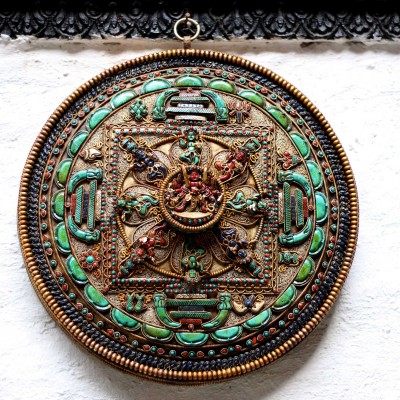
39cm Chakrasamvara Jogini Mandala, With Real Stone, Metal Setting And Gold Plated
Weight : 3.24kg | [16217]
US$1750
US$1487.5
You Save
US$262.5
(15%)
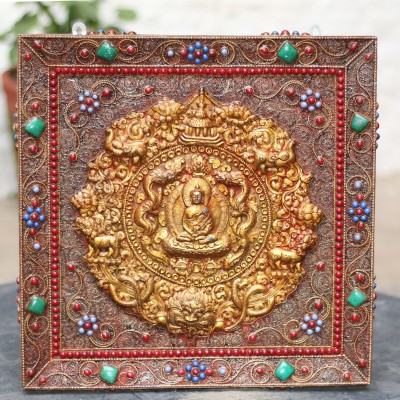
41cm Amitabha Buddha Wooden Wall Hanging With Siku Design And Metal Setting
Weight : 2kg | [16193]
US$300
US$255
You Save
US$45
(15%)
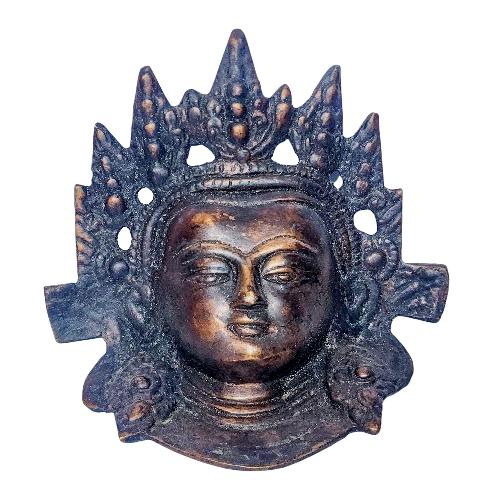
10cm Buddha Metal Mask, Buddhist Ritual Mask, Antique Finishing
Weight : 0.13kg | [31899]
US$10
US$8
You Save
US$2
(20%)
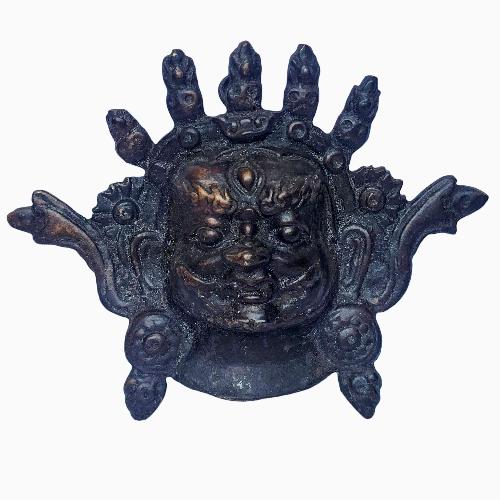
9cm Bhairav Metal Mask, Buddhist Ritual Mask, Antique Finishing
Weight : 0.13kg | [31900]
US$10
US$8
You Save
US$2
(20%)
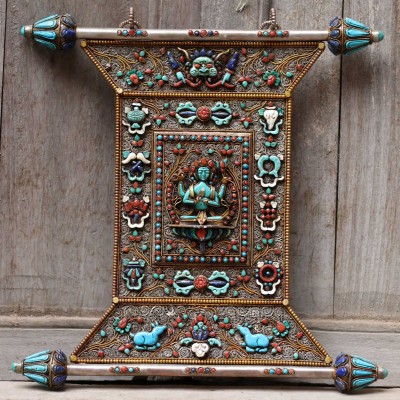
40cm Chengrezig Wooden Wall Hanging With Metal And Stone Setting, Gold Plated,cheppu On Top And Chengrezig As Main Motive And Ashtamangala On Sides
Weight : 1kg | [16274]
US$700
US$595
You Save
US$105
(15%)
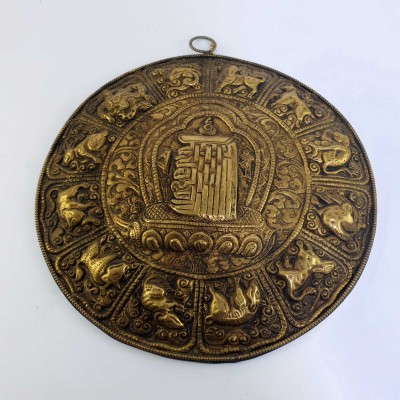
19cm Metal Kalachakra Mandala, Wall Hangings.tibetan Calendar With Kalachakra
Weight : 0.23kg | [18493]
US$22
US$18.7
You Save
US$3.3
(15%)
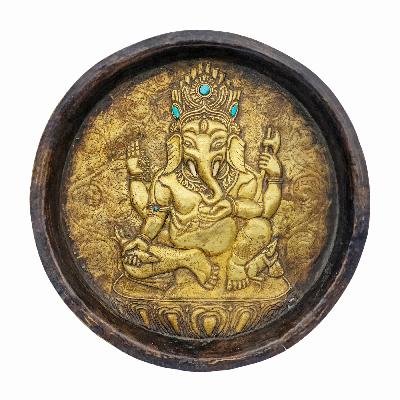
34cm Ganesh, Buddhist Handmade Wall Hanging, Stone Setting, Rare Find
Weight : 0.55kg | [29805]
US$600
US$480
You Save
US$120
(20%)
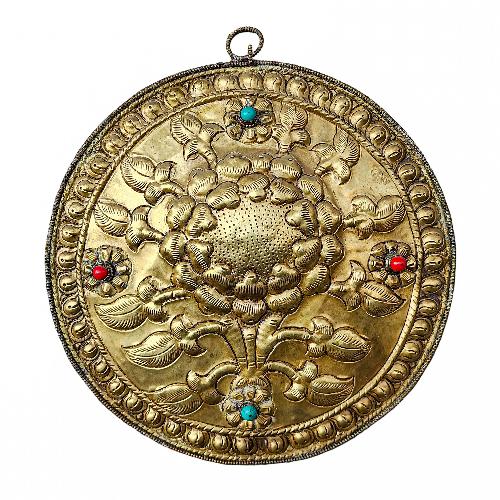
26cm Buddhist Metal Wall Hanging, Tibetan Calendar With Lotus
Weight : 0.5kg | [31540]
US$70
US$56
You Save
US$14
(20%)