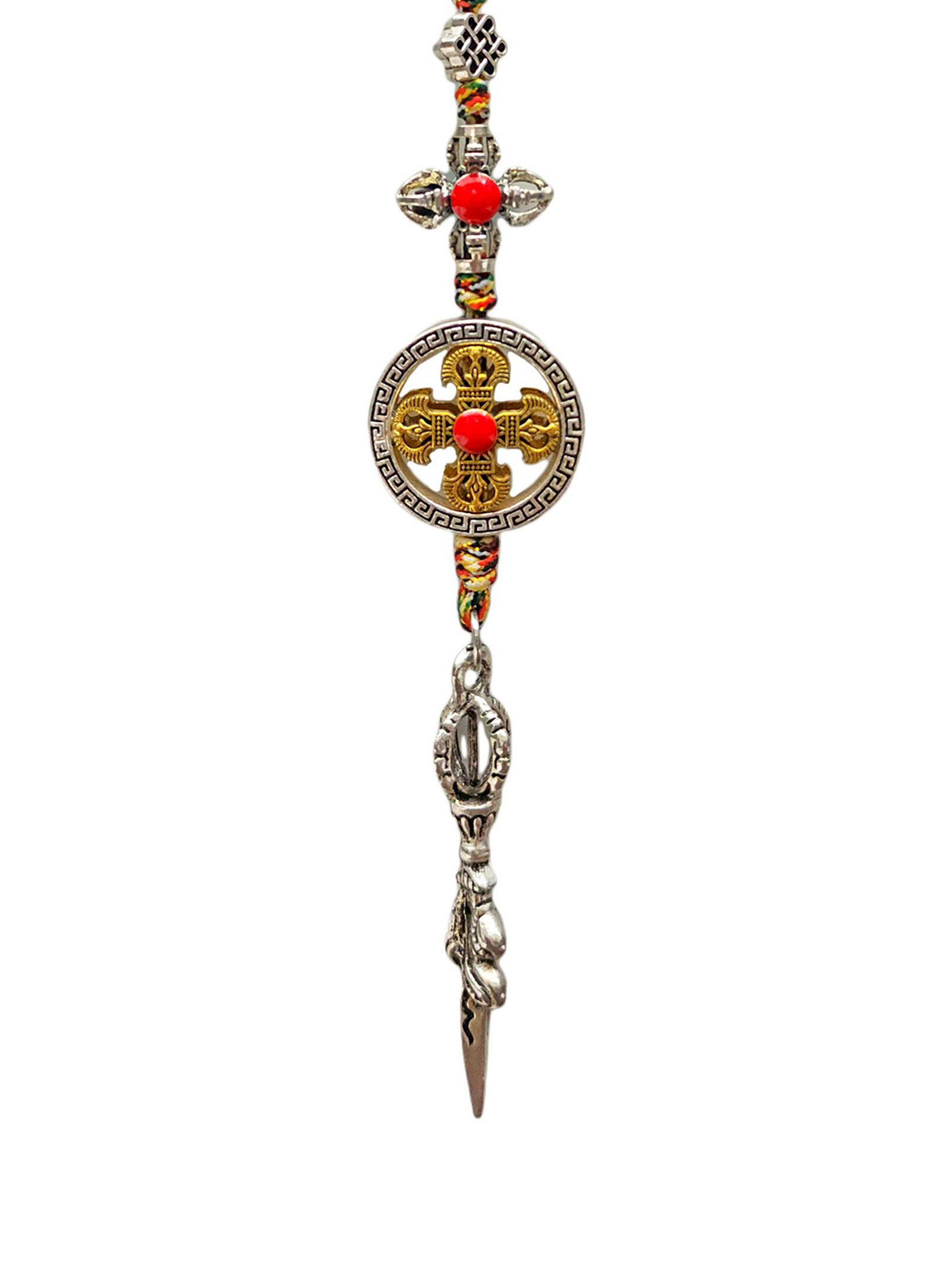
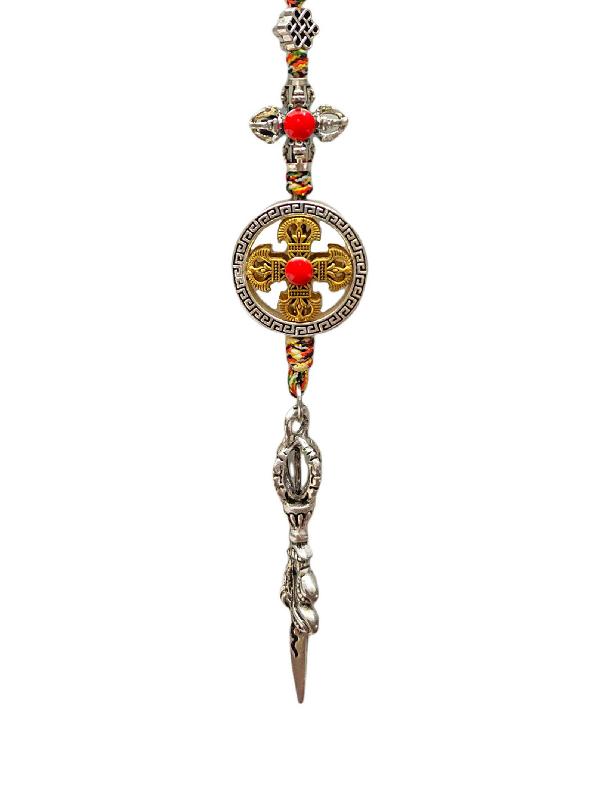
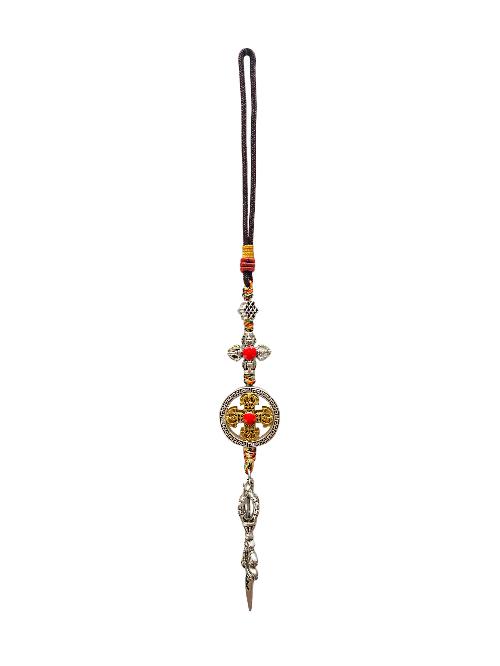
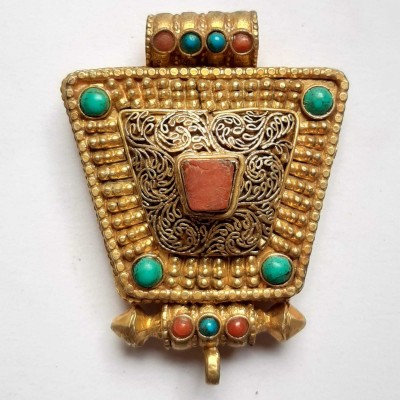
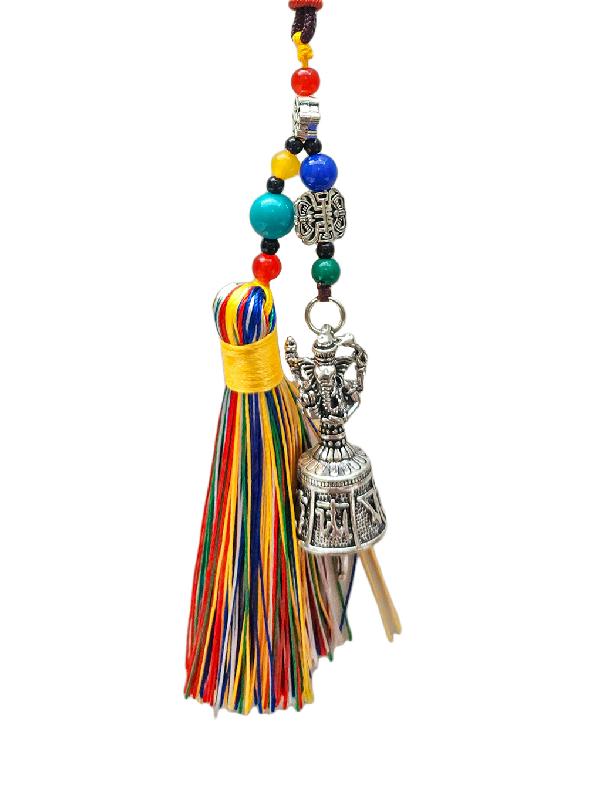
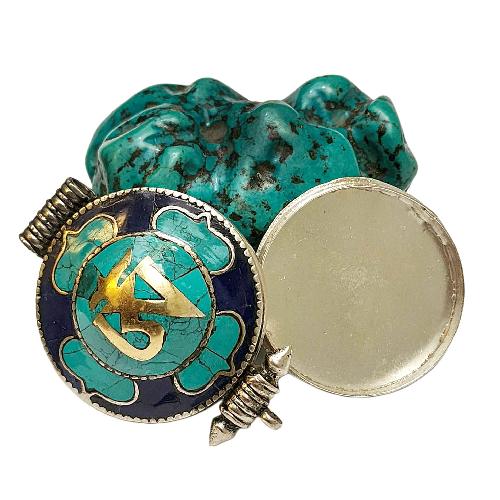
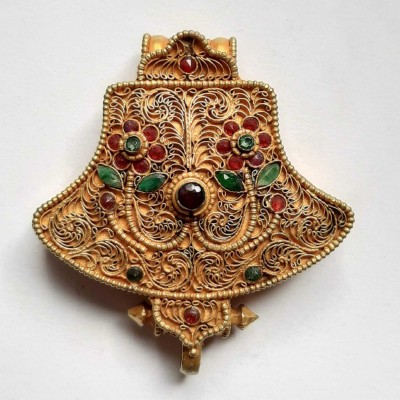
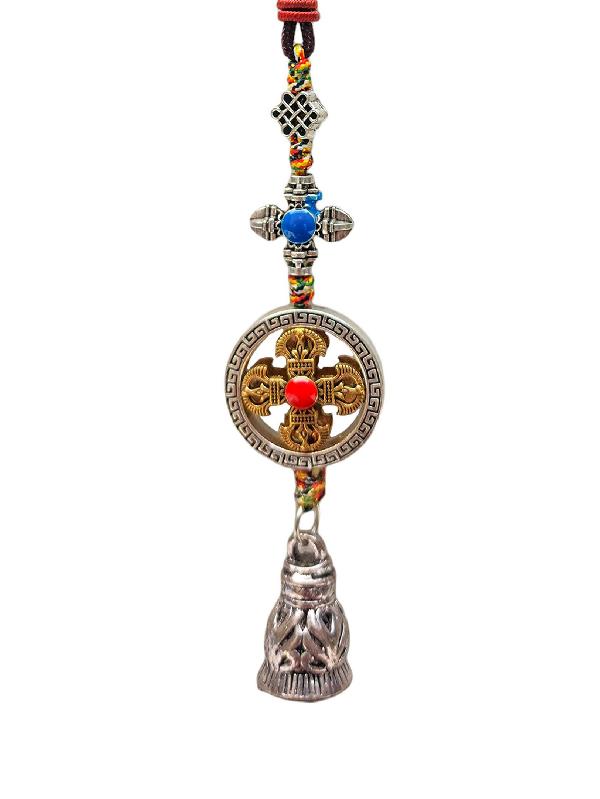
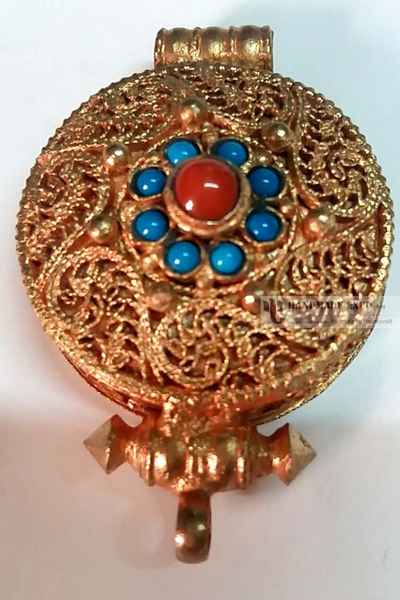
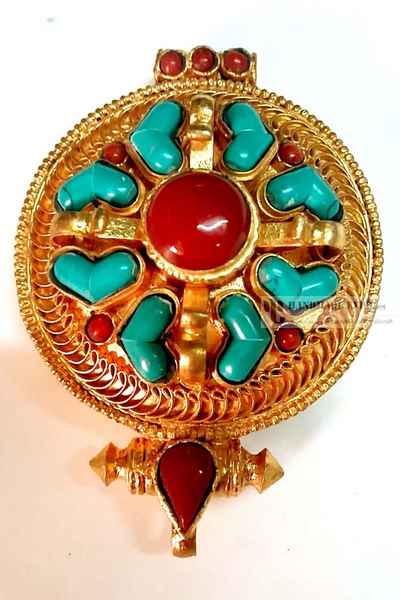
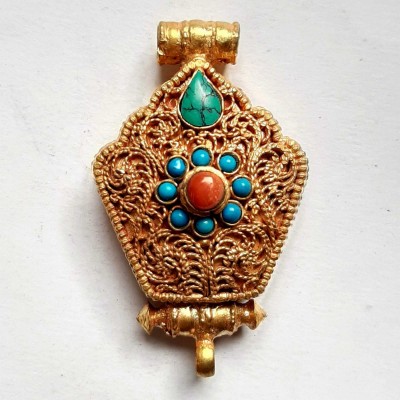
Mantra Amulet :these amulets are widely used by buddhist followers and devotees as the Jantra, not just for spiritual enlighten and good Fortune, But also as a shield protection from evil. These amulets are not just made to sell but are blessed by the High priest before they are send to be sold. They have all the required mantra and material needed to keep Oneself spiritually protected, and blessed.
Some may also define it as a small temple of the god with his / her mantra which you carry on yourself everywhere you go.
Phurba
: Iconographic The kīla(nail) or phurba is a three-sided peg, stake, knife, or nail like ritual implement traditionally associated with Indo-Tibetan Buddhism, The kīla is associated with the meditational deity Vajrakīla or Vajrakīlaya
Long description
Most of what is known of the Indian kīla lore has come by way of Tibetan culture. Scholars such as F. A. Bischoff, Charles Hartman and Martin Boord have shown that the Tibetan literature widely asserts that the Sanskrit for their term phurba is kīlaya (with or without the long i). However, as Boord describes it, "all dictionaries and Sanskrit works agree the word to be kīla (or kīlaka). I suppose this [discrepancy] to result from an indiscriminate use by Tibetans of the dative singular kīlaya. This form would have been familiar to them in the simple salutation namo vajrakīlaya (homage to Vajrakīla) from which it could easily be assumed by those unfamiliar with the technicalities of Sanskrit that the name of the deity is Vajrakīlaya instead of Vajrakīla. It should also be noted that the term (vajra)kīlaya is frequently found in Sanskrit texts (as well as in virtually every kīlamantra) legitimately used as the denominative verb 'to spike,' 'transfix,' 'nail down,' etc.
Mayer (1996) contests Boord's assertion, pointing out that eminent Sanskritists such as Sakya Pandita employed Vajrakīlaya Further, he argues:
it is possible, on the other hand, that the name Vajrakīlaya as favoured by the Tibetans could in fact have been the form that was actually used in the original Indic sources, and that there is no need to hypothesize a correct form Vajrakīla". "Vajrakīlaya" could have come from the second person singular active, causative imperative, of the verb Kīl. Indigenous grammar (Pāṇini Dhātupāṭha I.557) gives to Kīl the meaning of bandha, i.e. "to bind", while Monier-Williams (285) gives the meanings "to bind, fasten, stake, pin". Hence the form kīlaya could mean "you cause to bind/transfix!", or "bind/transfix!". This, taken from mantras urging "bind/transfix", or "may you cause to bind/transfix", might have come to be treated as a noun; and the noun might then have become deified; hence Kīlaya might have started out as a deified imperative, in some ways comparable to the famous example of the deified vocative in the name Hevajra, and a not unheard of phenomenon in Sanskrit tantric literature. This suggestion is supported by Alexis Sanderson, a specialist in Sanskrit tantric manuscripts whom I consulted on this problem.[3]
Fabrication and components
The fabrication of kīla is quite diverse. Having pommel, handle, and blade, kīla are often segmented into suites of triunes[4] on both the horizontal and vertical axes, though there are notable exceptions. This compositional arrangement highlights the numerological importance and spiritual energy of the integers three (3) and nine (9). Kīla may be constituted and constructed of different materials and material components, such as wood, metal, clay, bone, gems, horn or crystal. Wooden kīla are favored by shamans for healing and energetic work.[citation needed]
Like the majority of traditional Tibetan metal instruments, the kīla is often made from brass and iron (terrestrial and/or meteoric iron. 'Thokcha' (Tibetan: ཐོག་ལྕགས, Wylie: thog lcags) means "sky-iron" in Tibetan and denote tektites and meteorites which are often high in iron content. Meteoric iron was highly prized throughout the Himalaya where it was included in sophisticated polymetallic alloys such as Panchaloha for ritual implements. The pommel of the kīla often bears three faces of Vajrakīla, one joyful, one peaceful, one wrathful, but may bear the umbrella of the ashtamangala or mushroom cap, ishtadevata (like Hayagriva), snow lion, or stupa, among other possibilities. The handle is often of a vajra, weaving or knotwork design. The handle generally has a triune form as is common to the pommel and blade. The blade is usually composed of three triangular facets or faces, meeting at the tip. These represent, respectively, the blade's power to transform the negative energies known as the "three poisons" or "root poisons" (Sanskrit: mula klesha) of attachment/craving/desire, delusion/ignorance/misconception, and aversion/fear/hate.
Read More . . .
Phurba
: Iconographic The kīla(nail) or phurba is a three-sided peg, stake, knife, or nail like ritual implement traditionally associated with Indo-Tibetan Buddhism, The kīla is associated with the meditational deity Vajrakīla or Vajrakīlaya
Long description
Most of what is known of the Indian kīla lore has come by way of Tibetan culture. Scholars such as F. A. Bischoff, Charles Hartman and Martin Boord have shown that the Tibetan literature widely asserts that the Sanskrit for their term phurba is kīlaya (with or without the long i). However, as Boord describes it, "all dictionaries and Sanskrit works agree the word to be kīla (or kīlaka). I suppose this [discrepancy] to result from an indiscriminate use by Tibetans of the dative singular kīlaya. This form would have been familiar to them in the simple salutation namo vajrakīlaya (homage to Vajrakīla) from which it could easily be assumed by those unfamiliar with the technicalities of Sanskrit that the name of the deity is Vajrakīlaya instead of Vajrakīla. It should also be noted that the term (vajra)kīlaya is frequently found in Sanskrit texts (as well as in virtually every kīlamantra) legitimately used as the denominative verb 'to spike,' 'transfix,' 'nail down,' etc.
Mayer (1996) contests Boord's assertion, pointing out that eminent Sanskritists such as Sakya Pandita employed Vajrakīlaya Further, he argues:
it is possible, on the other hand, that the name Vajrakīlaya as favoured by the Tibetans could in fact have been the form that was actually used in the original Indic sources, and that there is no need to hypothesize a correct form Vajrakīla". "Vajrakīlaya" could have come from the second person singular active, causative imperative, of the verb Kīl. Indigenous grammar (Pāṇini Dhātupāṭha I.557) gives to Kīl the meaning of bandha, i.e. "to bind", while Monier-Williams (285) gives the meanings "to bind, fasten, stake, pin". Hence the form kīlaya could mean "you cause to bind/transfix!", or "bind/transfix!". This, taken from mantras urging "bind/transfix", or "may you cause to bind/transfix", might have come to be treated as a noun; and the noun might then have become deified; hence Kīlaya might have started out as a deified imperative, in some ways comparable to the famous example of the deified vocative in the name Hevajra, and a not unheard of phenomenon in Sanskrit tantric literature. This suggestion is supported by Alexis Sanderson, a specialist in Sanskrit tantric manuscripts whom I consulted on this problem.[3]
Fabrication and components
The fabrication of kīla is quite diverse. Having pommel, handle, and blade, kīla are often segmented into suites of triunes[4] on both the horizontal and vertical axes, though there are notable exceptions. This compositional arrangement highlights the numerological importance and spiritual energy of the integers three (3) and nine (9). Kīla may be constituted and constructed of different materials and material components, such as wood, metal, clay, bone, gems, horn or crystal. Wooden kīla are favored by shamans for healing and energetic work.[citation needed]
Like the majority of traditional Tibetan metal instruments, the kīla is often made from brass and iron (terrestrial and/or meteoric iron. 'Thokcha' (Tibetan: ཐོག་ལྕགས, Wylie: thog lcags) means "sky-iron" in Tibetan and denote tektites and meteorites which are often high in iron content. Meteoric iron was highly prized throughout the Himalaya where it was included in sophisticated polymetallic alloys such as Panchaloha for ritual implements. The pommel of the kīla often bears three faces of Vajrakīla, one joyful, one peaceful, one wrathful, but may bear the umbrella of the ashtamangala or mushroom cap, ishtadevata (like Hayagriva), snow lion, or stupa, among other possibilities. The handle is often of a vajra, weaving or knotwork design. The handle generally has a triune form as is common to the pommel and blade. The blade is usually composed of three triangular facets or faces, meeting at the tip. These represent, respectively, the blade's power to transform the negative energies known as the "three poisons" or "root poisons" (Sanskrit: mula klesha) of attachment/craving/desire, delusion/ignorance/misconception, and aversion/fear/hate.
Read More . . .
Double Dorje
: About Double Dorje The double vajra or crossed vajra is formed from four lotus-mounted vajra heads that emanate from a central hub towards the four cardinal directions and symbolizes the principle of absolute stability. In the cosmographic description of Mount Meru a vast crossed vajra supports and underlies the entire physical universe. Similarly in the representation of the mandala, a vast crossed vajra serves as the immoveable support or foundation of the mandala palace and here the central hub of the vajra is considered to be dark blue in color with the four heads colored to represent the four directions-white (East), yellow (South), red (West) and green (North). These also correspond to the five elements and the buddhas of the five families with blue Akshobhya in the center.
It's also an emblem of the green buddha of the north, Amoghasiddhi, and represents his all-accomplishing wisdom as lord of the karma family of activity.
The raised throne upon which masters are seated when teaching is traditionally decorated on the front by a hanging square of brocade displaying the image of a crossed vajra in the centre, often with four small swastikas in the corners. This emblem represents the unshakeable ground or reality of the Buddha's enlightenment.
Read More . . .
You may also want to read the related articles :
At Handmade Statue, we aim to provide a seamless and user-friendly experience. While our website is not a direct online shopping platform, we have a shopping cart system to make submitting your inquiries easy. Follow these steps to place your order:
Step 1: Browse Our Products
Explore our website to discover a wide range of authentic Nepali handicrafts, including statues, thangkas, singing bowls, wood carvings, jewelry, and more. Click on any product to view detailed descriptions and images.
Step 2: Add Items to Your Inquiry Cart
Click the “Add to Inquiry Cart” button for each product you are interested in. This will help you organize your selections conveniently.
Step 3: Review Your Inquiry Cart
Once you’ve added all your items, review your cart to ensure accuracy before submitting your inquiry.
Step 4: Submit Your Inquiry
Click the “Submit Inquiry” button. Fill out the form with your contact details, selected products, and any specific questions or customization requests.
Step 5: Communicate via Email
Since we don’t have an automated payment system, our team will respond to your inquiry via email. We’ll provide guidance, answer questions, and assist with customization requests.
Step 6: Finalize Your Order
Confirm all product details and customization options with our team. Once everything is finalized, we will provide secure payment instructions.
Step 7: Complete Your Payment
Make the payment through the provided method. After confirmation, we will process and prepare your order for shipment.
Step 8: Shipping and Delivery
We offer worldwide shipping. Once your order is dispatched, we will provide tracking details and shipping information.
Step 9: Receive and Enjoy Your Handicrafts
Unpack your beautiful handmade Nepali products and enjoy the craftsmanship and cultural heritage of Nepal.
Need Assistance?
If you face any issues or have questions while placing your order, contact us via email or mobile communication apps. Our team is dedicated to providing prompt support and a smooth ordering experience.
We hope this straightforward ordering process ensures a delightful and satisfying experience with Handmade Statue. Thank you for choosing us to connect you with the rich heritage of Nepali handicrafts.
Return Policy
We have a 7 days money back policy but buyer have to pay the return shipping charges.
Shipping
- Shipping cost is calculated, based on the shipping weight of the products ordered. THe normal Shipping cost is US$25 for upto 0.5 kgs weight
- We ship Worldwide, Except Russia and India.
- The deliver duration varies for international Shipping location. We normally dispatch the product in 2 -3 business days. Else Buyer will be infromed Personally about the shipping.
This is not a direct shopping website. So no payments are needed for placing an order. Please feel free to send us an order for the product you are interested in, mentioning the approximate quantity. Based on which we will send you a wholesale price quotation.