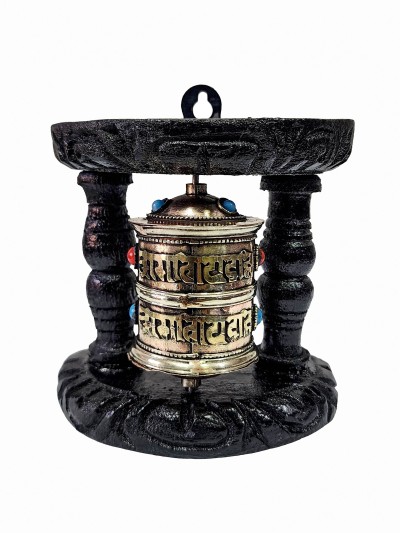
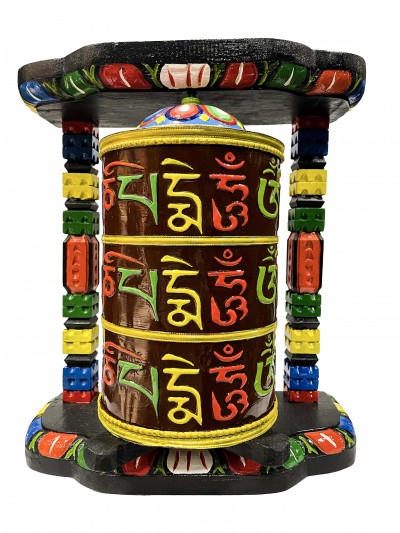
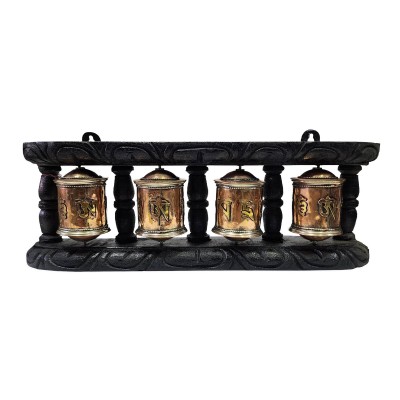
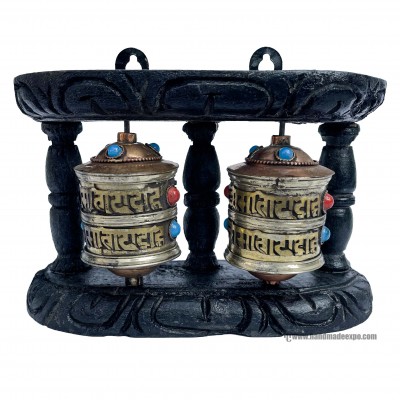
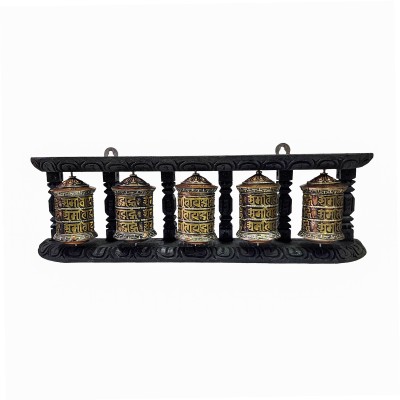
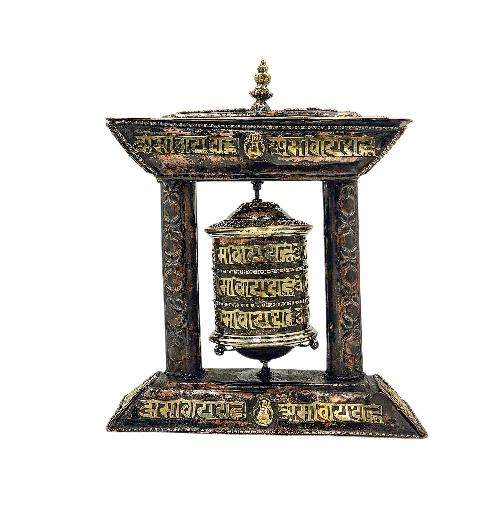
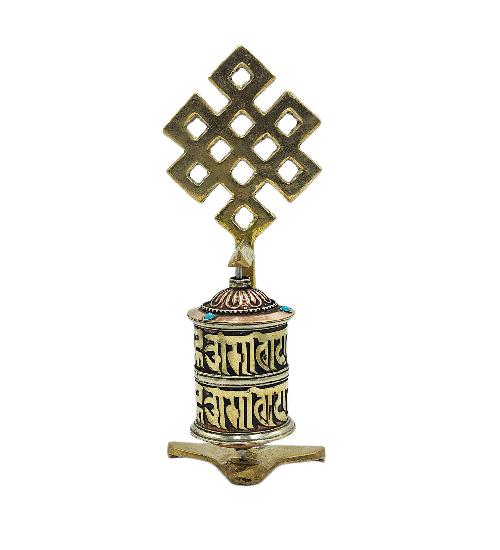
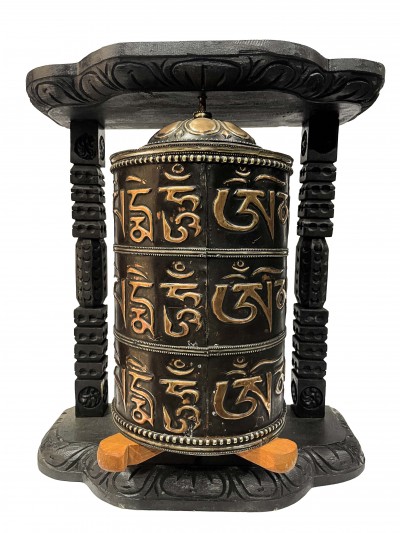
The shipping weight for 1 piece of the product is 1.50 kg, and shipping cost is USD42.00.
Note: Shipping Charge for this product will be calculated based on volumetric(dimensional) weight.
Country
Shipping Mode
We normally dispatch orders within 2 to 5 business days. If there are any delays, we will personally inform the buyer about the dispatch date.
We accept Paypal | Credit/Debit Card | Bank Transfer | Money Transfer / Remit Click Here for more Information.
We offer a simple 7-day money-back policy, with the buyer responsible for return shipping. Click Here for more Information.
Prayer Wheel :
A prayer wheel is a cylindrical wheel on a spindle made from metal, wood, stone, leather, or coarse cotton. Traditionally, the mantra Om Mani Padme Hum is written in the Newari language of Nepal, on the outside of the wheel. Also sometimes depicted are Dakinis, Protectors, and very often the 8 auspicious symbols Ashtamangala. At the core of the cylinder is a "Life Tree" often made of wood or metal with certain mantras written on or wrapped around it. Many thousands (or in the case of larger prayer wheels, millions) of mantras are then wrapped around this life tree. The Mantra Om Mani Padme Hum is most commonly used, but other mantras may be used as well. According to the Tibetan Buddhist tradition based on the lineage texts regarding prayer wheels, spinning such a wheel will have much the same meritorious effect as orally reciting the prayers.
Pancha Buddha
: The Ultimate Guide to Pancha Buddha: Meaning, Symbolism, and Sacred Art
What is Pancha Buddha?
Pancha Buddha, also widely known as the Five Dhyani Buddhas or the Five Wisdom Tathagatas, refers to a group of five primary Buddhas in Vajrayana Buddhism. They are not historical figures like Siddhartha Gautama, but rather transcendent beings representing the five fundamental qualities of the Buddha. These five deitiesâVairocana, Akshobhya, Ratnasambhava, Amitabha, and Amoghasiddhiâembody the transformation of negative human emotions into enlightened wisdom.
Importance in Vajrayana Buddhism and Mahayana Buddhism
In Vajrayana Buddhism and Mahayana Buddhism, the Pancha Buddha serves as the structural foundation for tantric teachings and iconography. They represent the cosmic mandala, a sacred map of the universe and the mind. Meditating upon the Five Dhyani Buddhas helps practitioners navigate the path to enlightenment by systematically overcoming ignorance, anger, pride, attachment, and jealousy. A complete Pancha Buddha statue set is considered essential for serious practitioners, monasteries, and collectors of sacred Buddhist art.
History and Origin of the Five Dhyani Buddhas
Historical Development
The concept of the Pancha Buddha developed progressively over centuries. While early Buddhism focused on the historical Shakyamuni Buddha, the Mahayana tradition expanded the cosmology to include countless Buddhas across different realms. By the time Vajrayana (Tantric) Buddhism flourished in India around the 6th to 8th centuries CE, the framework of the five cosmic Buddhas was fully crystallized.
Origins in Buddhist Scriptures
The primary textual origins of the Five Dhyani Buddhas are found in key tantric texts, particularly the Tattvasamgraha Tantra and the Guhyasamaja Tantra. These scriptures mapped out the Five Wisdoms and assigned specific cosmic Buddhas to represent them. They established a sophisticated system where every aspect of existenceâelements, directions, and psychological statesâwas correlated with one of these celestial beings.
Influence on Himalayan Buddhist Art and Culture
As Vajrayana teachings migrated across the Himalayas to Nepal, Tibet, and Bhutan, the Pancha Buddha became central to Himalayan Buddhist art. In Nepal, specifically within the Newar Buddhist tradition of the Kathmandu Valley, you will find their presence everywhereâfrom the towering stupas of Swayambhunath and Boudhanath (whose eyes watch over the four directions) to the intricate Nepalese Buddha statues crafted by local artisans.
The Five Dhyani Buddhas Explained
To truly understand Buddhist deities, one must examine the specific attributes of each Dhyani Buddha.
Quick Reference: The Pancha Buddha Attributes
Name
Direction
Color
Mudra (Gesture)
Symbol
Wisdom
Element
Vairocana
Center
White
Dharmachakra (Teaching)
Dharma Wheel
All-Accommodating
Space / Ether
Akshobhya
East
Blue
Bhumisparsha (Earth-touching)
Vajra (Thunderbolt)
Mirror-like
Water
Ratnasambhava
South
Yellow
Varada (Generosity)
Jewel
Equanimity
Earth
Amitabha
West
Red
Dhyana (Meditation)
Lotus
Discriminating
Fire
Amoghasiddhi
North
Green
Abhaya (Fearlessness)
Double Vajra
All-Accomplishing
Air / Wind
Vairocana Buddha
Meaning of the Name: "He who is like the sun" or "The Illuminator."
Spiritual Significance: Vairocana occupies the center of the mandala. He represents the ultimate, pure reality of the Dharma. Meditating on Vairocana transforms the poison of ignorance and delusion into the Wisdom of the Universal Law (All-Accommodating Wisdom).
Akshobhya Buddha
Meaning of the Name: "The Immovable One" or "The Unshakable."
Spiritual Significance: Facing the East, Akshobhya is associated with consciousness. His earth-touching mudra recalls the historical Buddha's triumph over Mara. He transforms the poison of anger and hatred into Mirror-like Wisdom, allowing one to see reality exactly as it is, without distortion.
Ratnasambhava Buddha
Meaning of the Name: "Born from the Jewel."
Spiritual Significance: Situated in the South, Ratnasambhava represents richness and spiritual wealth. His gesture of giving signifies boundless compassion. He transforms the poison of pride and greed into the Wisdom of Equanimity, recognizing the inherent equality of all beings.
Amitabha Buddha
Meaning of the Name: "Boundless Light" or "Infinite Light."
Spiritual Significance: Residing in the West (the Pure Land of Sukhavati), Amitabha is one of the most widely venerated Buddhas. He transforms the poison of lust, attachment, and desire into Discriminating Awareness Wisdom, the ability to understand the unique nature of all phenomena while recognizing their underlying unity.
Amoghasiddhi Buddha
Meaning of the Name: "Unfailing Success" or "Almighty Conqueror."
Spiritual Significance: Placed in the North, Amoghasiddhi represents the fearless action of a Buddha. His raised hand offers protection to all beings. He transforms the poison of jealousy and envy into All-Accomplishing Wisdom, enabling effortless, compassionate action for the benefit of all.
Symbolism of Pancha Buddha
The Pancha Buddha framework is highly systematic. Its symbolism maps the path of spiritual transformation.
Five Wisdoms: Each Buddha represents a specific facet of enlightenment, proving that the mind's impurities can be purified into brilliant awareness.
Five Elements: The physical universe (space, water, earth, fire, and air) is inextricably linked to the spiritual realm, showing the harmony between macrocosm and microcosm.
Five Directions: By covering the center and the four cardinal directions, the Dhyani Buddhas offer a blueprint for creating a sacred space (mandala) anywhere.
Transformation of Human Emotions: Vajrayana Buddhism does not seek to suppress negative emotions; rather, it uses tantric practices to transmute anger, pride, attachment, jealousy, and ignorance into pure spiritual fuel.
Pancha Buddha in Buddhist Art
Traditional Depictions
In Himalayan Buddhist art, the Five Dhyani Buddhas are frequently depicted together.
Thangkas: Painted scrolls show the Buddhas arranged in a precise mandala layout, with Vairocana in the center and the other four at the cardinal points.
Mandalas: Geometric spiritual maps use the colors of the Pancha Buddha to guide meditation.
Statues: A Five Buddha statue set is often placed on primary altars. They share similar physical proportions and monastic robes but are distinguished uniquely by their specific hand gestures (mudras), colors, and seating atop different animal thrones (such as the lion, elephant, horse, peacock, and garuda).
Importance in Monasteries and Temples
No Tibetan or Newar Buddhist monastery is complete without representations of the Pancha Buddha. Their icons crown the arches of doorways, embellish the peaks of stupas, and sit on the highest tiers of the main shrine, radiating blessings to all who enter.
Handmade Pancha Buddha Statues from Nepal
Nepal, particularly the Kathmandu Valley, is the historical epicenter for crafting premium Buddhist sculpture. If you are looking for a handmade Pancha Buddha, understanding the craftsmanship is essential.
Traditional Lost-Wax Casting Process
Nepal Handicrafts are famous worldwide for the ancient lost-wax casting technique. Artisans sculpt a precise model in beeswax, encase it in clay, and fire it. The wax melts away ("lost wax"), leaving a perfect mold for pouring molten copper, bronze, or brass. This ensures every Vajrayana Buddhist statue is a unique, unrepeatable masterpiece.
Hand Carving and Finishing Techniques
Once cast, master artisans spend weeksâsometimes monthsâchasing and hand-carving the metal. They refine the intricate floral motifs on the robes, sharpen the facial features to express deep serenity, and perfect the symbolic implements.
Fire Gilding and Precious Metals
For premium Buddhist altar statues, artisans use an ancient fire gilding process, applying an amalgam of pure 24K gold and mercury. When heated, the mercury evaporates, leaving a thick, brilliant layer of gold permanently bonded to the copper or bronze base. Statues can be crafted in copper, brass, bronze, silver, or pure gold, often adorned with semi-precious stones like turquoise, lapis lazuli, and coral.
Benefits of Keeping a Pancha Buddha Statue
Owning a Pancha Buddha Statue set is far more than an aesthetic choice.
Meditation Support: They act as focal points for visualization practices. A Buddhist meditation statue helps steady the mind and reminds the practitioner of the specific wisdom they are cultivating.
Spiritual Inspiration: The presence of the Five Buddhas transforms an ordinary room into a sacred space, fostering peace, mindfulness, and discipline.
Symbol of Wisdom and Compassion: They serve as daily visual reminders to overcome negative emotions and cultivate a compassionate heart.
Sacred Art Collection: Authentic Nepalese Buddha statues hold immense cultural value and often appreciate as heirloom pieces of fine art.
Read More . . .
Om - Hindu
: About OM It is the most sacred syllable symbol and mantra of Brahman, the Almighty God in Hinduism. Brahman is the Supreme Self, Ultimate Reality, and Creator of all Existence. The syllable is often chanted either independently or before a mantra; it signifies the essence of the ultimate reality, consciousness, or Atma. The Om sound is the primordial sound and is called the Shabda-Brahman (Brahman as sound). In Hinduism, Om is one of the most important spiritual sounds. It refers to Atman (soul, self within) and Brahman (ultimate reality, entirety of the universe, truth, divine, supreme spirit, cosmic principles, knowledge). The syllable is often found at the beginning and the end of chapters in the Vedas, the Upanishads, and other Hindu texts. It is a sacred spiritual incantation made before and during the recitation of spiritual texts, during puja and private prayers, in ceremonies of rites of passage (sanskara) such as weddings, and sometimes during meditative and spiritual activities such as Yoga. Om came to be used as a standard utterance at the beginning of mantras, chants, or citations taken from the Vedas. For example, the Gayatri mantra, which consists of a verse from the Rigveda Samhita (RV 3.62.10), is prefixed not just by Om but by Om followed by the formula bh?r bhuva? sva?. Such recitations continue to be in use in Hinduism, with many major incantations and ceremonial functions beginning and ending with Om. Maheshwarananda (2002) suggests that the Om reflects the cosmological beliefs in Hinduism, as the primordial sound associated with the creation of the universe from nothing.
Detail Description
The syllable Om is referred to as praṇava. Other used terms are akṣara (literally, letter of the alphabet, imperishable, immutable) or ekākṣara (one letter of the alphabet) and omkāra (meaning literally
"Om syllable", and connoting: a beginning and female divine energy). Udgitha, a word found in Sama Veda and bhasya (commentaries) based on it, is also used as a name of the syllable. The word has three phonemes: "a-u-m", though it is often described as trisyllabic despite this being either archaic or the result of translation.
The syllable Om is first mentioned in the Upanishads, the mystical texts associated with the Vedanta philosophy. It has variously been associated with concepts of "cosmic sound" or "mystical syllable" or "affirmation to something divine", or as symbolism for abstract spiritual concepts in the Upanishads. In the Aranyaka and the Brahmana layers of Vedic texts, the syllable is so widespread and linked to knowledge, that it stands for the "whole of Veda". The etymological foundations of Om are repeatedly discussed in the oldest layers of the Vedantic texts (the early Upanishads). The Aitareya Brahmana of Rig Veda, in section 5.32, for example suggests that the three phonetic components of Om (pronounced AUM) correspond to the three stages of cosmic creation, and when it is read or said, it celebrates the creative powers of the universe. The Brahmana layer of Vedic texts equate Om with Bhur-bhuvah-Svah, the latter symbolizing "the whole Veda". They offer various shades of meaning to Om, such as it being "the universe beyond the sun", or that which is "mysterious and inexhaustible", or "the infinite language, the infinite knowledge", or "essence of breath, life, everything that exists", or that "with which one is liberated". The Sama Veda, the poetical Veda, orthographically maps Om to the audible, the musical truths in its numerous variations (Oum, Aum, Ovā Ovā Ovā Um, etc.) and then attempts to extract musical meters from it.
The syllable Om evolves to mean many abstract ideas in the earliest Upanishads. Max M?ller and other scholars state that these philosophical texts recommend Om as a "tool for meditation", explain various meanings that the syllable may be in the mind of one meditating, ranging from "artificial and senseless" to "highest concepts such as the cause of the Universe, essence of life, Brahman, Atman, and Self-knowledge".
Read More . . .
Origin :
The earliest recorded prayer wheels were written of by a Chinese pilgrim around 400 C.E. in Ladakh.prayer wheel is a physical manifestation of the phrase "turning the wheel of Dharma," which describes the way in which the Buddha taught. Prayer Wheels originated from The School of Shakyamuni sutra, which states that, those who set up the place for worship, use the knowledge to propagate the dharma to common people, should there be any man or woman who are illiterate and unable to read the sutra, they should then set up the prayer wheel to facilitate those illiterate to chant the sutra, and the effect is the same as reading the sutra
According to the Tibetan tradition, the prayer wheel lineage traces back to the famous Indian master, Arya Nagarjuna. Tibetan texts also say that the practice was taught by the Indian Buddhist masters Tilopa and Naropa as well as the Tibetan masters Marpa and Milarepa.
Practice :
According to the lineage texts on prayer wheels, prayer wheels are used to accumulate wisdom and merit (good karma) and to purify negativities (bad karma). In Buddhism, Buddhas and Bodhisattvas have created a variety of skillful means (upaya) to help bring practitioners ever closer to realizing enlightenment. The idea of spinning mantras relates to numerous Tantric practices whereby the Tantric practitioner visualizes mantras revolving around the nadis and especially around the meridian chakras such as the heart and crown. Therefore, prayer wheels are a visual aid for developing one's capacity for these types of Tantric visualizations. The spiritual method for those practicing with a prayer wheel is very specific (with slight variations according to different Buddhist sects). The practitioner most often spins the wheel clockwise, as the direction in which the mantras are written is that of the movement of the sun across the sky. On rare occasions, advanced Tantric practitioners such as Senge Dongma, the Lion-Faced Dakini, spin prayer wheels counterclockwise to manifest a more wrathful protective energy. As the practitioner turns the wheel, it is best to focus the mind and repeat the Om Mani Padme Hum mantra. Not only does this increase the merit earned by the wheel's use, but it is a mind-stabilization technique that trains the mind while the body is in motion. Intoning the mani mantra with mindfulness and the "Bodhicitta" motivation dramatically enhances the effects of the prayer wheel. However, it is said that even turning it while distracted has benefits and merits, and it is stated in the lineage text that even insects that cross a prayer wheel's shadow will get some benefit. Each revolution is as meritorious as reading the inscription aloud as many times as it is written on the scroll, and this means that the more Om Mani Padme Hum mantras that are inside a prayer wheel, the more powerful it is. It is best to turn the wheel with a gentle rhythm and not too fast or frantically. While turning smoothly, one keeps in mind the motivation and spirit of compassion and bodhichitta (the noble mind that aspires to full enlightenment for the benefit of all beings). The benefits attributed to the practice of turning the wheel are vast. Not only does it help wisdom, compassion and bodhichitta arise in the practitioner, it also enhances siddhis (spiritual powers such as clairvoyance, precognition, reading others thoughts, etc.). The practitioner can repeat the mantra as many times as possible during the turning of the wheel, stabilizing a calm, meditative mind. At the end of a practice session, there is a Tibetan Buddhist tradition of dedicating any accumulated merits that one may have gathered during practice to the benefit of all sentient beings. Then Om Ah Hum 3 times. This is customary with Tibetans upon completing any Buddhist practice, including the practice of the prayer wheel.
Thubten Zopa Rinpoche has commented that installing a prayer wheel has the capacity to completely transform a place, which becomes "...peaceful, pleasant, and conducive to the mind." Simply touching a prayer wheel is said to bring great purification to negative karmas and obscurations.
H.E. Garchen Rinpoche - The Benefits of Spinning a Prayer Wheel
You may also want to read the related articles :
At Handmade Statue, we aim to provide a seamless and user-friendly experience. While our website is not a direct online shopping platform, we have a shopping cart system to make submitting your inquiries easy. Follow these steps to place your order:
Step 1: Browse Our Products
Explore our website to discover a wide range of authentic Nepali handicrafts, including statues, thangkas, singing bowls, wood carvings, jewelry, and more. Click on any product to view detailed descriptions and images.
Step 2: Add Items to Your Inquiry Cart
Click the “Add to Inquiry Cart” button for each product you are interested in. This will help you organize your selections conveniently.
Step 3: Review Your Inquiry Cart
Once you’ve added all your items, review your cart to ensure accuracy before submitting your inquiry.
Step 4: Submit Your Inquiry
Click the “Submit Inquiry” button. Fill out the form with your contact details, selected products, and any specific questions or customization requests.
Step 5: Communicate via Email
Since we don’t have an automated payment system, our team will respond to your inquiry via email. We’ll provide guidance, answer questions, and assist with customization requests.
Step 6: Finalize Your Order
Confirm all product details and customization options with our team. Once everything is finalized, we will provide secure payment instructions.
Step 7: Complete Your Payment
Make the payment through the provided method. After confirmation, we will process and prepare your order for shipment.
Step 8: Shipping and Delivery
We offer worldwide shipping. Once your order is dispatched, we will provide tracking details and shipping information.
Step 9: Receive and Enjoy Your Handicrafts
Unpack your beautiful handmade Nepali products and enjoy the craftsmanship and cultural heritage of Nepal.
Need Assistance? If you face any issues or have questions while placing your order, contact us via email or mobile communication apps. Our team is dedicated to providing prompt support and a smooth ordering experience. We hope this straightforward ordering process ensures a delightful and satisfying experience with Handmade Statue. Thank you for choosing us to connect you with the rich heritage of Nepali handicrafts.
Return Policy
We have a 7 days money back policy but buyer have to pay the return shipping charges.
Shipping
Shipping cost is calculated, based on the shipping weight of the products ordered. THe normal Shipping cost is US$25 for upto 0.5 kgs weight
We ship Worldwide, Except Russia and India.
The deliver duration varies for international Shipping location. We normally dispatch the product in 2 -3 business days. Else Buyer will be infromed Personally about the shipping.
This is not a direct shopping website. So no payments are needed for placing an order. Please feel free to send us an order for the product you are interested in, mentioning the approximate quantity. Based on which we will send you a wholesale price quotation.
Related Products
12cm Wall Prayer Wheel With Mantra Inside, With Carved Mantra, Stone Setting, Wall Mountable, Wall Mountable
![Buddhist Handmade Wall Prayer Wheel With Mantra Inside, [omph], [pancha Buddha], Table Top](https://www.handmadeexpo.com/pics/product/35234.jpg)

![Buddhist Handmade Wall Prayer Wheel With Mantra Inside, [omph], [pancha Buddha], Table Top](https://www.handmadeexpo.com/pics/product/thumb/35234.jpg)
![Buddhist Handmade Wall Prayer Wheel With Mantra Inside, [omph], [pancha Buddha], Table Top](https://www.handmadeexpo.com/pics/product/thumb/35234_0.jpg)
![Buddhist Handmade Wall Prayer Wheel With Mantra Inside, [omph], [pancha Buddha], Table Top](https://www.handmadeexpo.com/pics/product/thumb/35234_1.jpg)
![Buddhist Handmade Wall Prayer Wheel With Mantra Inside, [omph], [pancha Buddha], Table Top](https://www.handmadeexpo.com/pics/product/thumb/35234_2.jpg)
![Buddhist Handmade Wall Prayer Wheel With Mantra Inside, [omph], [pancha Buddha], Table Top](https://www.handmadeexpo.com/pics/product/thumb/35234_3.jpg)