The shipping weight for 1 piece of the product is 0.50 kg, and shipping cost is USD31.00.
Note: Shipping Charge for this product will be calculated based on volumetric(dimensional) weight.
Country
Shipping Mode
We normally dispatch orders within 2 to 5 business days. If there are any delays, we will personally inform the buyer about the dispatch date.
We accept Paypal | Credit/Debit Card | Bank Transfer | Money Transfer / Remit Click Here for more Information.
We offer a simple 7-day money-back policy, with the buyer responsible for return shipping. Click Here for more Information.
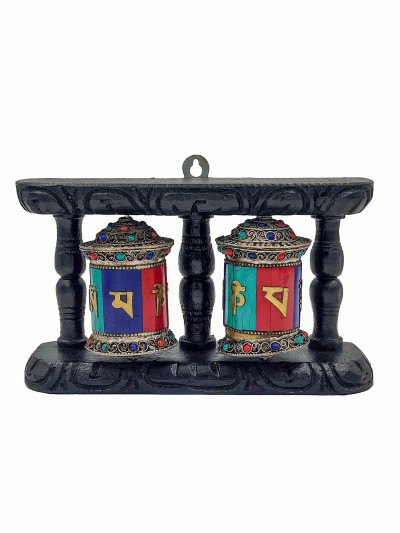
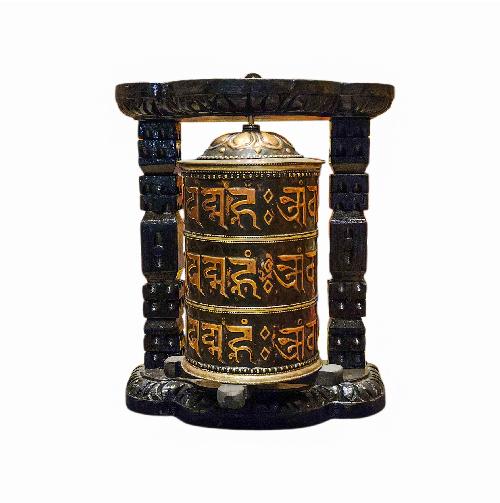
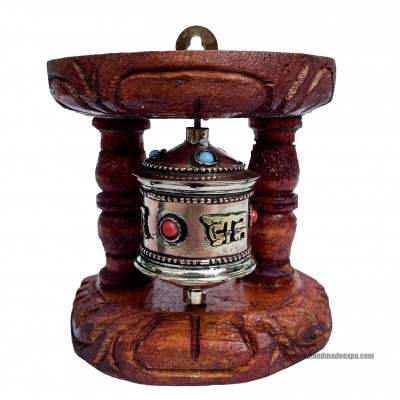
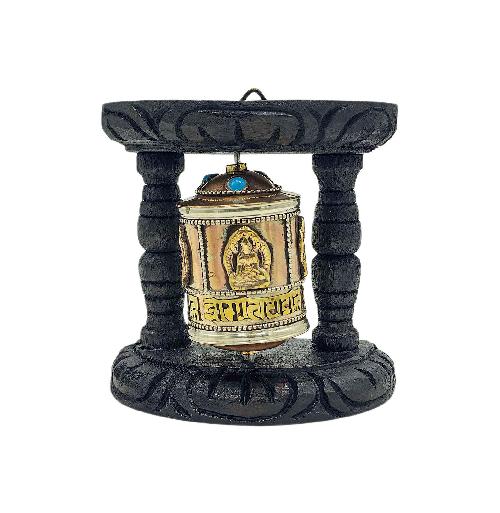
Prayer Wheel :
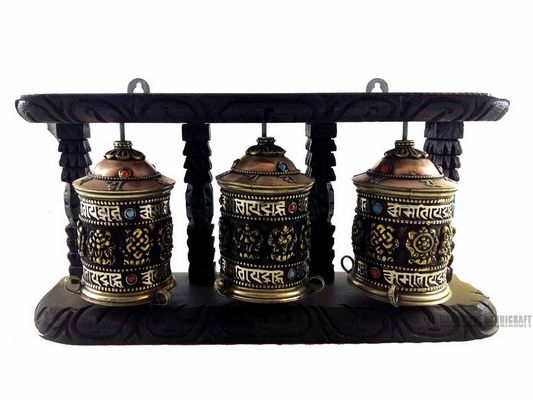
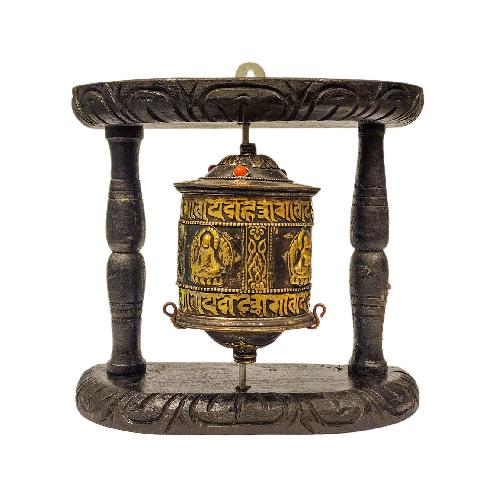
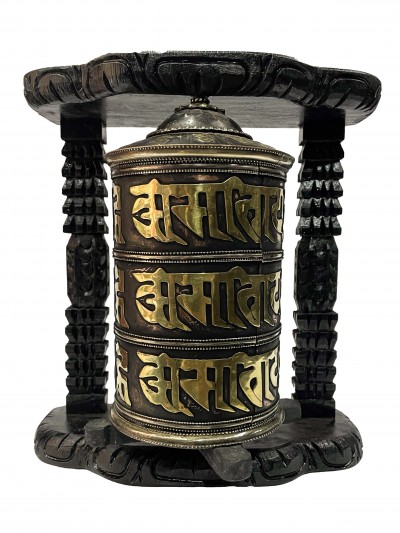
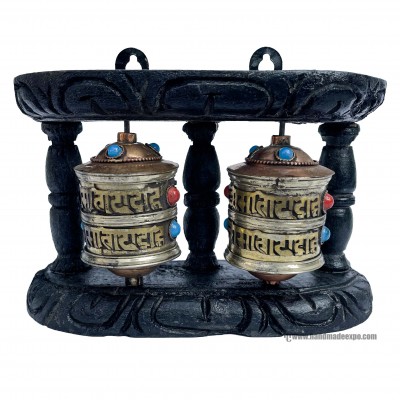
A prayer wheel is a cylindrical wheel on a spindle made from metal, wood, stone, leather, or coarse cotton. Traditionally, the mantra Om Mani Padme Hum is written in the Newari language of Nepal, on the outside of the wheel. Also sometimes depicted are Dakinis, Protectors, and very often the 8 auspicious symbols Ashtamangala. At the core of the cylinder is a "Life Tree" often made of wood or metal with certain mantras written on or wrapped around it. Many thousands (or in the case of larger prayer wheels, millions) of mantras are then wrapped around this life tree. The Mantra Om Mani Padme Hum is most commonly used, but other mantras may be used as well. According to the Tibetan Buddhist tradition based on the lineage texts regarding prayer wheels, spinning such a wheel will have much the same meritorious effect as orally reciting the prayers.
Finishing: Stone Setting
The Prayer Wheel is adorned with an exquisite array of semi-precious stones, including turquoise, coral, and lapis lazuli. These stones are carefully selected and meticulously placed on the Prayer Wheel's surface, adding a touch of opulence and enhancing its overall beauty. Each stone is thoughtfully positioned using a high-quality adhesive, ensuring secure and long-lasting attachment. The vibrant colors and unique patterns of the stones create a captivating contrast against the backdrop of the Prayer Wheel, elevating its visual appeal and making it truly eye-catching.
Beyond their decorative purpose, these semi-precious stones carry symbolic significance in various cultures and traditions. Turquoise is often associated with protection and healing, coral represents vitality and passion, while lapis lazuli symbolizes wisdom and truth. The inclusion of these stones not only adds to the aesthetic allure of the Prayer Wheel but also imbues it with deeper meaning and cultural symbolism.
The intricate placement of these semi-precious stones showcases the meticulous craftsmanship and attention to detail that goes into the creation of the Prayer Wheel. It is a testament to the skill and artistic vision of the artisans who delicately adorn the statue, resulting in a truly remarkable and captivating piece of art.
In the sacred arts of Nepal and Tibet, the Ashtamangala symbols transcend mere ornamentation; they function as a visual language map representing the spiritual attributes and physical form of the Buddha's enlightened body.
Sanskrit Name
Common English Name
Symbolic Spiritual Meaning
Buddha's Body Association
Chattra
Precious Parasol
Spiritual protection from suffering, desire, and obstacles
The Head
Suvarnamatsya
Two Golden Fishes
Fearlessness, liberation from samsara, and spiritual abundance
The Eyes
Padma
Sacred Lotus
Primordial purity of body, speech, and mind rising above defilements
The Tongue
Shankha
White Conch Shell
The pervasive, melodious sound of the Dharma awakening beings
The Speech
Kalasha (Bumpa)
Treasure Vase
Inexhaustible spiritual wealth, prosperity, and long life
The Neck
Shrivatsa
Endless Knot
Interconnectedness of all existence; union of wisdom and compassion
The Mind
Dhvaja
Victory Banner
The triumph of enlightenment over ignorance, fear, and death
The Body
Dharmachakra
Wheel of Dharma
The turning of the spiritual law and the Noble Eightfold Path
The Feet
The White Conch Shell (Shankha)
The Shankha represents the profound voice of the Buddha and the spreading of the truth. Iconographically, the most sacred form is the right-turning or clockwise-twisting white conch shell. Its deep, resonant sound represents the sovereign, awakening blast of the Dharma that rouses disciples from the deep slumber of cosmic ignorance and inspires them to accomplish the welfare of all beings.
The Endless Knot (Shrivatsa)
The Shrivatsa, or eternal knot, is a mesmerizing geometric matrix with no discernible beginning or end. This symbol represents the absolute interconnectedness of all things via the web of cause and effect (karma). On a higher philosophical level, it represents the complete union of seemingly opposite dualities: appearance and emptiness, samsara and nirvana, andâmost cruciallyâthe inseparability of Wisdom (Prajna) and Compassion (Karuna).
The Two Golden Fishes (Suvarnamatsya)
Originally symbolizing the two sacred rivers of ancient Indiaâthe Ganges and the Yamunaâthe Two Golden Fishes are traditionally depicted swimming vertically. In Buddhist iconography, they symbolize freedom and total fearlessness. Just as fish swim effortlessly through the vast ocean without danger of drowning, an enlightened being navigates the vast ocean of samsara (the cycle of rebirth) with absolute liberation and joy. They also represent domestic fidelity and spiritual abundance.
The Sacred Lotus (Padma)
The Padma or lotus flower is the definitive symbol of primordial purity and renunciation. Because the lotus roots itself deep in the murky mud at the bottom of a pond yet rises through the water to bloom completely immaculate on the surface, its iconography represents the soul rising above the muddy waters of attachment and desire to realize its inherent Buddha-nature.
The Precious Parasol (Chattra)
The Chattra or parasol mimics the protective dome of the heavens. In traditional iconography, the wide canopy represents wisdom, while the hanging silken skirt symbolizes various compassionate methods. It represents the protection of the Dharma, shielding practitioners from the scorching heat of mental afflictions, negative karma, and worldly suffering.
The Treasure Vase (Kalasha / Bumpa)
The Kalasha (known as Bumpa in Tibetan tradition) is modeled after traditional flat-based, round clay water pots, typically capped with a brilliant, flaming jewel. Iconographically, it represents an endless reservoir of spiritual and material wealth. No matter how much nectar is poured out from the vase to bless sentient beings, it remains eternally full, symbolizing health, long life, and the inexhaustible nature of wisdom.
The Wheel of Dharma (Dharmachakra)
The Dharmachakra is the primary symbol of Buddhism itself, representing the spiritual teachings set in motion by the Buddha during his first sermon at Sarnath. The wheel typically features eight distinct spokes, which explicitly map the Noble Eightfold Path to liberation: Right View, Right Intention, Right Speech, Right Action, Right Livelihood, Right Effort, Right Mindfulness, and Right Concentration.
The Victory Banner (Dhvaja)
Originally deployed as a military standard on the battlefields of ancient India, the Dhvaja was adopted into Buddhist iconography to signify spiritual triumph. It represents the Buddhaâs decisive victory over the armies of Mara (the personification of delusion, spiritual death, and desire). Placed on temple roofs and shrines, it denotes the absolute victory of knowledge over ignorance.
Frequently Asked Questions About the Ashtamangala
What do the eight auspicious symbols represent?
The eight auspicious symbols (Ashtamangala) represent the primordial cosmic offerings presented by Vedic deities to Gautama Buddha upon his enlightenment. Collectively, they symbolize the qualities of the enlightened mind and map out the physical, sacred anatomy of the Buddha's body.
Where should the Ashtamangala symbols be placed?
In traditional practices across Nepal and Tibet, the Ashtamangala symbols are painted, carved, or embroidered on household entryways, monasteries, altars, and sacred metallic offering bowls. Displaying them in a living space or meditation area is believed to invite protective energy, harmony, and spiritual alignment while dispelling negative obstacles.
Why are the symbols interpreted differently across cultures?
While the core spiritual philosophies remain unified, the visual styling varies. For instance, Newari master sculptors in Kathmandu cast the symbols with highly ornate, classical details flowing from centuries-old lost-wax metal-work traditions, whereas Tibetan motifs often favor bold, geometric textile block-prints. Both schools, however, preserve the foundational Sanskrit iconography.
Read More . . .
Om Mani Padme Hum
: What is Om Mani Padme Hum "Om Mani Padme Hum" is a sacred mantra in Tibetan Buddhism that holds deep spiritual significance. It is associated with Avalokiteshvara, the bodhisattva of compassion. The mantra is a powerful invocation and is believed to encompass the essence of compassion, wisdom, and enlightenment.
Each syllable of the mantra represents a specific quality:
"Om" represents the pure exalted body, speech, and mind of enlightened beings.
"Mani" symbolizes the jewel, which stands for the altruistic intention to attain enlightenment.
"Padme" means lotus and represents wisdom.
"Hum" signifies indivisibility and unity.
When reciting or meditating upon this mantra, practitioners aim to cultivate compassion, wisdom, and a deep understanding of the interconnectedness of all beings. It is believed to have the power to purify negative emotions, liberate from suffering, and lead toward enlightenment.
The mantra is often chanted, written, or inscribed on prayer flags, wheels, and stones. Its resonance and repetition are said to create positive vibrations that benefit both the practitioner and the surrounding environment.
Read More . . .
Origin :
The earliest recorded prayer wheels were written of by a Chinese pilgrim around 400 C.E. in Ladakh.prayer wheel is a physical manifestation of the phrase "turning the wheel of Dharma," which describes the way in which the Buddha taught. Prayer Wheels originated from The School of Shakyamuni sutra, which states that, those who set up the place for worship, use the knowledge to propagate the dharma to common people, should there be any man or woman who are illiterate and unable to read the sutra, they should then set up the prayer wheel to facilitate those illiterate to chant the sutra, and the effect is the same as reading the sutra
According to the Tibetan tradition, the prayer wheel lineage traces back to the famous Indian master, Arya Nagarjuna. Tibetan texts also say that the practice was taught by the Indian Buddhist masters Tilopa and Naropa as well as the Tibetan masters Marpa and Milarepa.
Practice :
According to the lineage texts on prayer wheels, prayer wheels are used to accumulate wisdom and merit (good karma) and to purify negativities (bad karma). In Buddhism, Buddhas and Bodhisattvas have created a variety of skillful means (upaya) to help bring practitioners ever closer to realizing enlightenment. The idea of spinning mantras relates to numerous Tantric practices whereby the Tantric practitioner visualizes mantras revolving around the nadis and especially around the meridian chakras such as the heart and crown. Therefore, prayer wheels are a visual aid for developing one's capacity for these types of Tantric visualizations. The spiritual method for those practicing with a prayer wheel is very specific (with slight variations according to different Buddhist sects). The practitioner most often spins the wheel clockwise, as the direction in which the mantras are written is that of the movement of the sun across the sky. On rare occasions, advanced Tantric practitioners such as Senge Dongma, the Lion-Faced Dakini, spin prayer wheels counterclockwise to manifest a more wrathful protective energy. As the practitioner turns the wheel, it is best to focus the mind and repeat the Om Mani Padme Hum mantra. Not only does this increase the merit earned by the wheel's use, but it is a mind-stabilization technique that trains the mind while the body is in motion. Intoning the mani mantra with mindfulness and the "Bodhicitta" motivation dramatically enhances the effects of the prayer wheel. However, it is said that even turning it while distracted has benefits and merits, and it is stated in the lineage text that even insects that cross a prayer wheel's shadow will get some benefit. Each revolution is as meritorious as reading the inscription aloud as many times as it is written on the scroll, and this means that the more Om Mani Padme Hum mantras that are inside a prayer wheel, the more powerful it is. It is best to turn the wheel with a gentle rhythm and not too fast or frantically. While turning smoothly, one keeps in mind the motivation and spirit of compassion and bodhichitta (the noble mind that aspires to full enlightenment for the benefit of all beings). The benefits attributed to the practice of turning the wheel are vast. Not only does it help wisdom, compassion and bodhichitta arise in the practitioner, it also enhances siddhis (spiritual powers such as clairvoyance, precognition, reading others thoughts, etc.). The practitioner can repeat the mantra as many times as possible during the turning of the wheel, stabilizing a calm, meditative mind. At the end of a practice session, there is a Tibetan Buddhist tradition of dedicating any accumulated merits that one may have gathered during practice to the benefit of all sentient beings. Then Om Ah Hum 3 times. This is customary with Tibetans upon completing any Buddhist practice, including the practice of the prayer wheel.
Thubten Zopa Rinpoche has commented that installing a prayer wheel has the capacity to completely transform a place, which becomes "...peaceful, pleasant, and conducive to the mind." Simply touching a prayer wheel is said to bring great purification to negative karmas and obscurations.
H.E. Garchen Rinpoche - The Benefits of Spinning a Prayer Wheel
You may also want to read the related articles :
At Handmade Statue, we aim to provide a seamless and user-friendly experience. While our website is not a direct online shopping platform, we have a shopping cart system to make submitting your inquiries easy. Follow these steps to place your order:
Step 1: Browse Our Products
Explore our website to discover a wide range of authentic Nepali handicrafts, including statues, thangkas, singing bowls, wood carvings, jewelry, and more. Click on any product to view detailed descriptions and images.
Step 2: Add Items to Your Inquiry Cart
Click the “Add to Inquiry Cart” button for each product you are interested in. This will help you organize your selections conveniently.
Step 3: Review Your Inquiry Cart
Once you’ve added all your items, review your cart to ensure accuracy before submitting your inquiry.
Step 4: Submit Your Inquiry
Click the “Submit Inquiry” button. Fill out the form with your contact details, selected products, and any specific questions or customization requests.
Step 5: Communicate via Email
Since we don’t have an automated payment system, our team will respond to your inquiry via email. We’ll provide guidance, answer questions, and assist with customization requests.
Step 6: Finalize Your Order
Confirm all product details and customization options with our team. Once everything is finalized, we will provide secure payment instructions.
Step 7: Complete Your Payment
Make the payment through the provided method. After confirmation, we will process and prepare your order for shipment.
Step 8: Shipping and Delivery
We offer worldwide shipping. Once your order is dispatched, we will provide tracking details and shipping information.
Step 9: Receive and Enjoy Your Handicrafts
Unpack your beautiful handmade Nepali products and enjoy the craftsmanship and cultural heritage of Nepal.
Need Assistance? If you face any issues or have questions while placing your order, contact us via email or mobile communication apps. Our team is dedicated to providing prompt support and a smooth ordering experience. We hope this straightforward ordering process ensures a delightful and satisfying experience with Handmade Statue. Thank you for choosing us to connect you with the rich heritage of Nepali handicrafts.
Return Policy
We have a 7 days money back policy but buyer have to pay the return shipping charges.
Shipping
Shipping cost is calculated, based on the shipping weight of the products ordered. THe normal Shipping cost is US$25 for upto 0.5 kgs weight
We ship Worldwide, Except Russia and India.
The deliver duration varies for international Shipping location. We normally dispatch the product in 2 -3 business days. Else Buyer will be infromed Personally about the shipping.
This is not a direct shopping website. So no payments are needed for placing an order. Please feel free to send us an order for the product you are interested in, mentioning the approximate quantity. Based on which we will send you a wholesale price quotation.
Related Products
12.5cm Three Prayer Wheel Set On Wooden Frame, Wall Mountable
![Buddhist Handmade Wall Prayer Wheel With Mantra Inside, [omph], [ashtamangala], [stone Setting], Wall Mountable](https://www.handmadeexpo.com/pics/product/35091.jpg)

![Buddhist Handmade Wall Prayer Wheel With Mantra Inside, [omph], [ashtamangala], [stone Setting], Wall Mountable](https://www.handmadeexpo.com/pics/product/thumb/35091.jpg)
![Buddhist Handmade Wall Prayer Wheel With Mantra Inside, [omph], [ashtamangala], [stone Setting], Wall Mountable](https://www.handmadeexpo.com/pics/product/thumb/35091_0.jpg)
![Buddhist Handmade Wall Prayer Wheel With Mantra Inside, [omph], [ashtamangala], [stone Setting], Wall Mountable](https://www.handmadeexpo.com/pics/product/thumb/35091_1.jpg)
![Buddhist Handmade Wall Prayer Wheel With Mantra Inside, [omph], [ashtamangala], [stone Setting], Wall Mountable](https://www.handmadeexpo.com/pics/product/thumb/35091_2.jpg)
![Buddhist Handmade Wall Prayer Wheel With Mantra Inside, [omph], [ashtamangala], [stone Setting], Wall Mountable](https://www.handmadeexpo.com/pics/product/thumb/35091_3.jpg)