The shipping weight for 1 piece of the product is 0.50 kg, and shipping cost is USD31.00.
Note: Shipping Charge for this product will be calculated based on volumetric(dimensional) weight.
Country
Shipping Mode
We normally dispatch orders within 2 to 5 business days. If there are any delays, we will personally inform the buyer about the dispatch date.
We accept Paypal | Credit/Debit Card | Bank Transfer | Money Transfer / Remit Click Here for more Information.
We offer a simple 7-day money-back policy, with the buyer responsible for return shipping. Click Here for more Information.
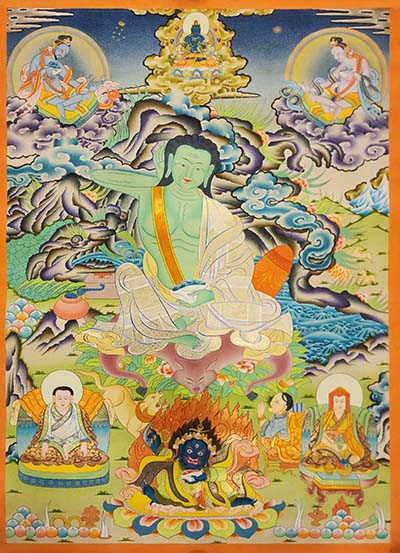
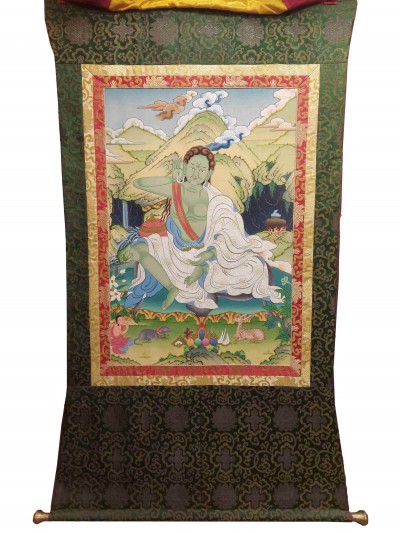
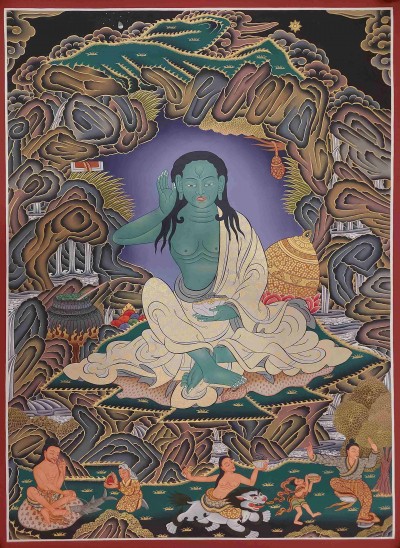
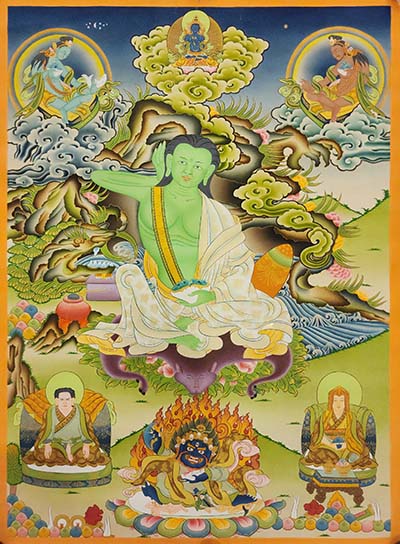
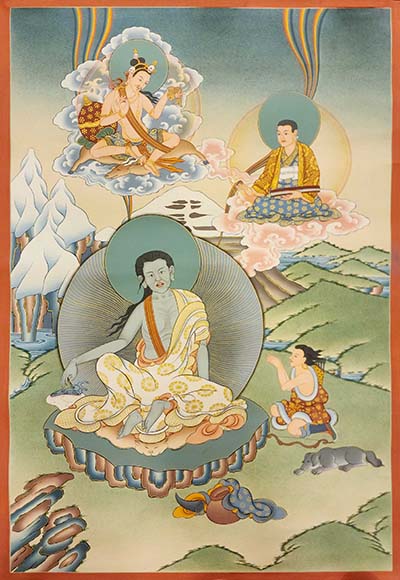
Milarepa :
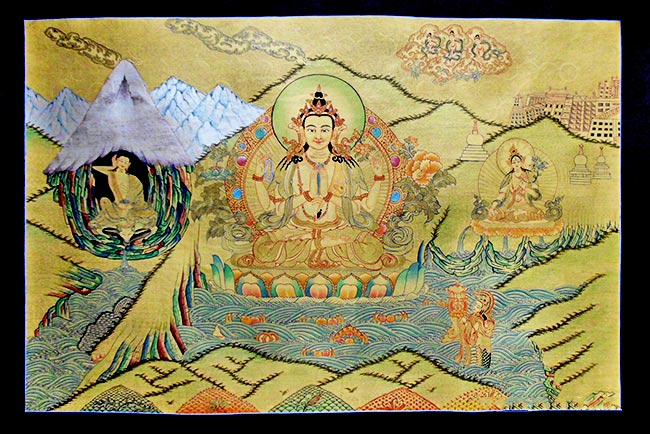
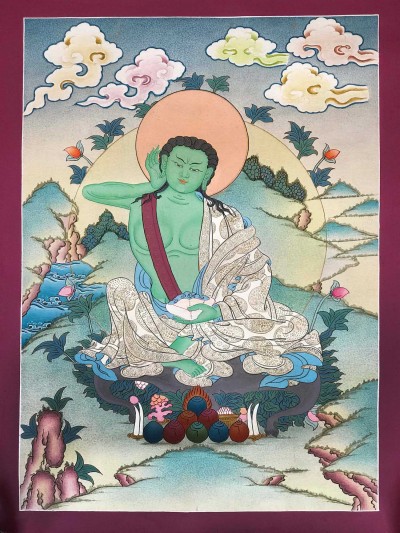
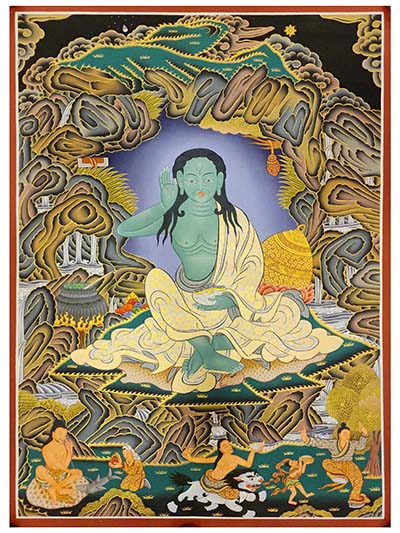
Milarepa is one of the most widely known Tibetan Saints. In a superhuman effort, he rose above the miseries of his younger life and with the help of his Guru, Marpa the Translator, took to a solitary life of meditation until he had achieved the pinnacle of the enlightened state, never to be born again into the Samsara (whirlpool of life and death) of worldly existence. Out of compassion for humanity, he undertook the most rigid asceticism to reach the Buddhic state of enlightenment and to pass his accomplishments on to the rest of humanity. His spiritual lineage was passed along to his chief disciples, Gambopa and Rechung. It was Rechung who recorded in detail the incidents of Milarepa's life for posterity. The narrative of his life has thus been passed down through almost a millennium of time and has become an integral part of Tibetan culture. In addition to Rechung's narrative of his life, summarized below, Milarepa extemporaneously composed innumerable songs throughout his life relevant to the dramatic turns of events of himself and his disciples in accordance with an art form that was in practice at the time. These songs have been widely sung and studied in Tibet ever since and have been recorded as the Hundred Thousand Songs of Milarepa. His faithful devotion, boundless religious zeal, monumental forbearance, superhuman perseverance, and ultimate final attainment are a great inspiration today for all. His auspicious life illumined the Buddhist faith and brought the light of wisdom to sentient beings everywhere.
Introduction to Thangka
A thangka, also known as tangka, thanka, or tanka, is a vibrant and intricate Tibetan Buddhist painting that serves as a visual representation of spiritual teachings. Crafted with meticulous detail on cotton or silk appliqu?, thangkas depict a wide range of subjects including Buddhist deities, sacred scenes, mandalas, and narrative stories. These sacred artworks are traditionally kept unframed and rolled up for storage, resembling ancient scrolls. To protect their delicate nature, thangkas are mounted on textile backings and often adorned with a silk cover on the front. Proper preservation in dry environments is crucial to maintain the integrity and longevity of the silk.
These sacred paintings serve as objects of contemplation, inspiration, and instruction, guiding practitioners on their spiritual path. Thangkas provide a visual gateway to the world of Tibetan Buddhism, encapsulating its rich symbolism, iconography, and spiritual concepts. With their vibrant colors, intricate patterns, and skillful craftsmanship, thangkas offer a profound visual medium for deepening one's understanding and connection to the teachings of Buddhism.
Thangkas come in various sizes, ranging from small pieces resembling Western half-length portraits to grand-scale creations spanning several meters in each dimension. While the larger thangkas are intended for temporary display during religious festivals, the majority of these artworks are designed for personal meditation or as educational aids for monastic students. The compositions of thangkas are meticulously crafted, featuring intricate details and often incorporating numerous small figures. A central deity or focal point is typically surrounded by a symmetrical arrangement of other divine beings, symbols, or narrative elements that convey profound spiritual teachings.
How is Thangka made
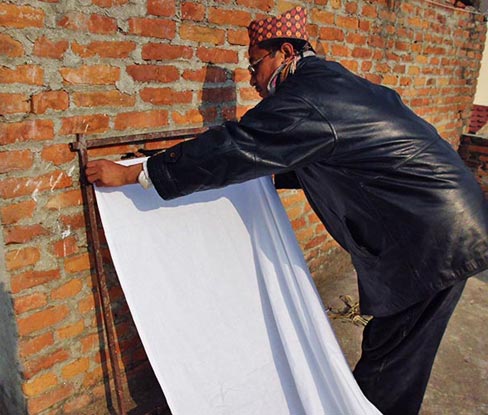
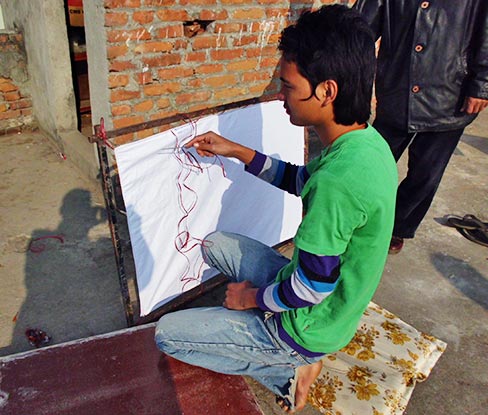
First, the canvas on which the painting is to be executed is laid on a wooden frame to determine the required dimensions. This canvas is an extremely finely woven cotton material, referred to in the Holy Scriptures as "?ura Canvas".
Then the canvas is cut, hemmed and, with the use of sturdy strings, very tightly mounted in the wooden frame. Painting is carried out with the frame in an upright position, without any further rigid support or backing.
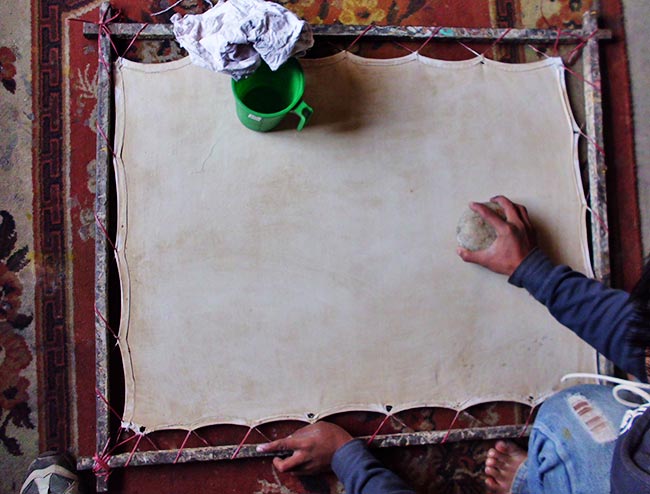
In this studio, our primary artist, who works virtually exclusively for us, applies the undercoat consisting of a mixture of chalk and glue to the canvas by hand. Other Thangka workshops have turned to mainly using industrially pre-primed canvas.
This photo shows how the canvas, after receiving its base coat followed by a second coating of bone glue, is polished and smoothed by hand with a stone to attain a perfectly smooth, featureless painting surface. Through this process the canvas becomes quite rigid, thereby providing perfect conditions to evoke very finest artistic detail and over-all superior painting quality.
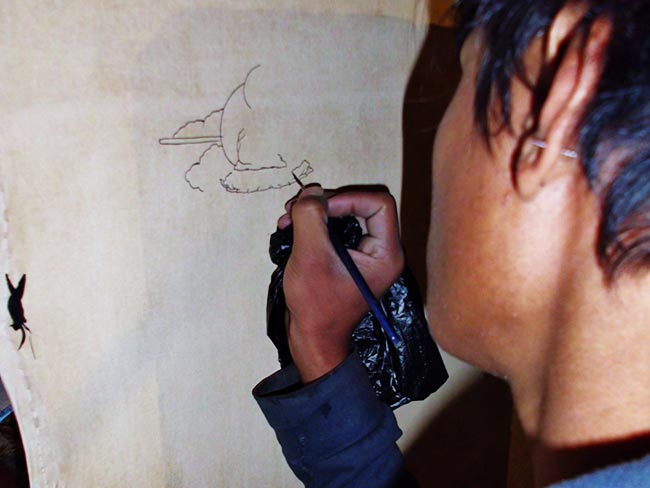
Using a different Thangka, we see how, after mounting, the complete basic pattern of the respective theme is applied to the canvas.
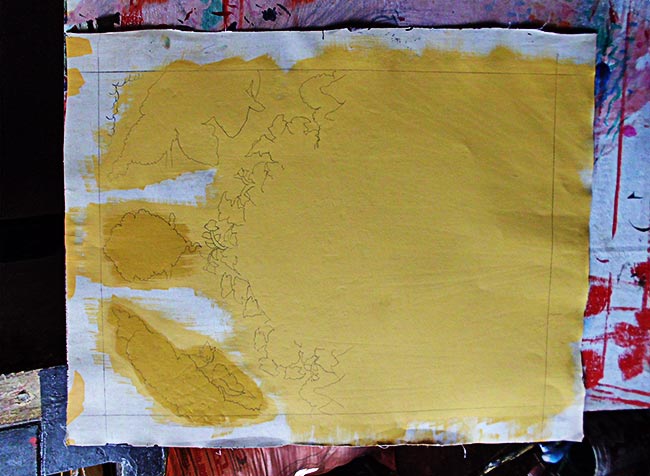
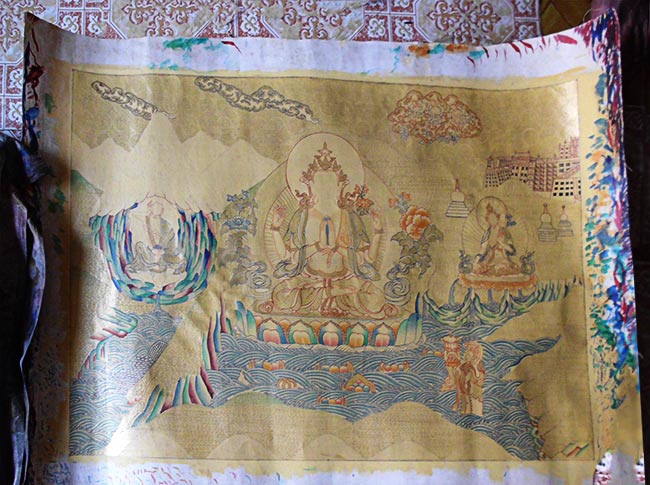
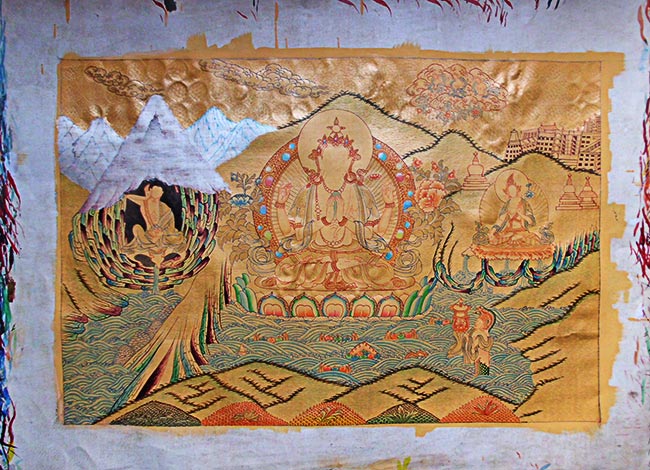
The following picture shows the steps in creating a gold-based Thangka, such as our No PH 9, the "Holy Mount Kailash". To achieve more intensive colour, yet another prime coat, in ochre, is applied, followed by a coat of pure gold. The so-called Thangka painting gold is traditionally produced by members of the Newar people in Nepal. 24-karat gold is ground to finest powder and mixed with bone glue and water in proportions suitable for direct use in painting. Thus, the Thangka gold is not gold leaf at all! Silver can be processed and used in the same way: Mount Kailash and the surrounding peaks in our completed Thangka were not painted with white paint, rather with precious silver.
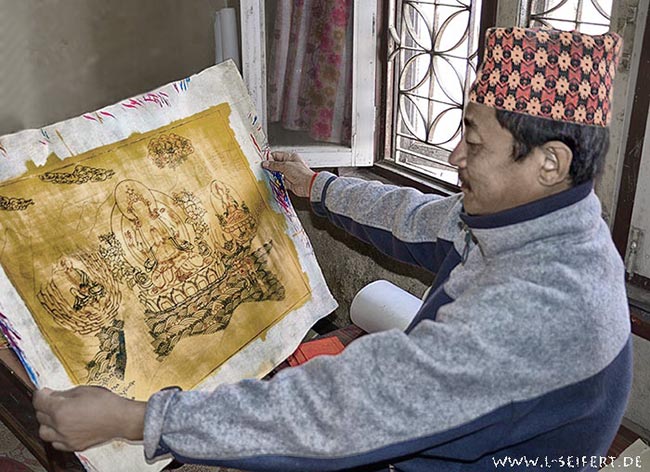
Here, the nearly completed piece has been removed from the wooden frame. Now only the very finest finishing touches remain to be added, such as compacting the gold and giving Mount Kailash its silver mantle.
K. Lama regarded his already half-finished thangka proudly
The Mount Kailash Thangka, including the black margin (which can also facilitate the fastening of a traditional brocade frame), is now complete. Only the background gold must be compacted in the places where it is later intended to exhibit a sheen.
Here we see an old ballpoint pen casing into which a specially cut agate has been fitted. The back of this semi-precious stone is slightly concave and can be used to compact gold over extensive areas of the Thangka, while the blunt point is used to lineally compact gold, thus creating a shiny effect.
In this way, through partial compaction of the gold or refraining from compaction, nearly three-dimensional effects can be achieved. The glorious sheen of gold artistically treated in this way richly rewards the beholder or meditator with a Thangka possessed of an extraordinarily aesthetic aura.
Thangka Making Video
Read More . . .
Use of Real Gold
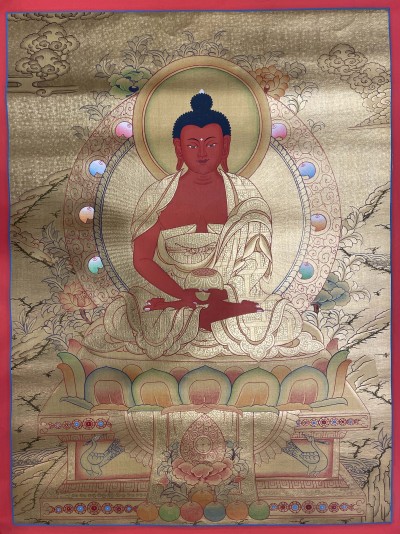
This thangka of Milarepa has real gold painted on its surface along with other paints. This is an ancient process of decorating the thangka in Tibetan Buddhism, Here gold is ground into gold dust, which is then mixed with other undisclosed material to make it paintable on the canvas. this mixture is then mixed with transparent glue and painted on the thangka.
Videos of Applying Gold in the Thangka
Read More . . .
Gampopa
: Brief Introduction Gampopa "the man from Gampo" (Tibetan: སྒམ་པོ་པ་) S?nam Rinchen (Tibetan: བསོད་ནམས་རིན་ཆེན་, Wylie: bsod nams rin chen, 1079-1153) was a Tibetan Buddhist teacher in the Kagyu lineage, as well as a doctor and tantric master who founded the Dhagpo Kagyu school. He is also known as Dvag Popa, and the titles Dakpo Lharj? "the physician from Dakpo" (Tibetan: དྭགས་པོ་ལྷ་རྗེ་, Wylie: dwags po lha rje) and Da? Zh?nnu, "Chandraprabha Kumar" (Tibetan: ཟླ་འོད་ཞོན་ནུ་, Wylie: zla 'od gzhon nu).
Biography
Gampopa was born in the Nyal (or Nyel) district, Central Tibet and from an early age was a student of medicine in the Indian, Chinese and Tibetan medical traditions. Later in his life he moved to the region of Dakpo (dwags po) in southern Tibet and hence was also called Dakpopa (dwags po pa), the man from Dakpo. The region is also near Gampo Hills, hence his other name, Gampopa. In his youth Gampopa studied under the Nyingma lama Barey as well as under the Kadampa teacher Geshe Yontan Drag. He married a daughter of a man named Chim Jose Darma Wo (mchims jo sras dar ma 'od) and had a child, but they both died, causing him to renounce the householder's life. In 1104, at the age of twenty-five he took ordination, either in Dakpo or in Penyul, at Gyachak Ri monastery ('phan yul rgya lcags ri), receiving the name S?nam Rinchen (bsod nams rin chen)." After becoming a monk in the Kadampa lineage under Geshe Loden Sherab and focused on studying the Kadampa teachings. In his 30s he sought out and became the foremost student of the yogi Milarepa. Milarepa instructed him in the practice of Vajravārahī, tummo (gtum mo) and Mahāmudrā.
Gampopa's position in the transmission lineage of the Mahamudra teaching is as follows:
Tilopa (988-1069), the Indian yogi who experienced the original transmission of the Mahamudra
Naropa (1016-1100), who perfected the methods of accelerated enlightenment described in his Six Yogas of Naropa.
Marpa (1012-1097), the first Tibetan in the lineage, who translated the Vajrayana and Mahamudra texts into Old Tibetan
Milarepa (1052-1135), poet and master who overcame Marpa's reluctance to teach but nonetheless attained enlightenment in a single lifetime
Gampopa, Milarepa's most important student, who integrated Atiśa's Kadam teachings and Tilopa's Mahamudra teaching to establish the Kagy? lineage
This lineage sequence, taken together, is called the "Five Founding Masters" by the Kagyu school.
After his studies with Milarepa, Gampopa founded Dakhla Gampo Monastery (Dwags lha sgam po) in 1121 CE. He had many great students who were accomplished tantric practitioners, both monks and laymen. Gampopa's teaching joined the Lamrim teachings of the Kadampa school with the Mahamudra and tantric teachings of the Kagyu school. According to Tony Duff, he taught Mahamudra in two approaches, "one is a gradual approach called the Four Yogas of Mahamudra, the other is a sudden approach called Essence Mahamudra.
Teachings Gampopa most famous teaching is known as "The Four Dharmas of Gampopa", this is outlined in a key text of Gampopa called The Four Dharmas in Brief:
"It is necessary for: dharma to turn to dharma; dharma to turn into the path; the path to dispel confusion; and confusion to turn into wisdom"
The Four Dharmas in Brief further states about each of the four Dharmas:
(1) Dharma to turn to dharma means to meditate on impermanence, the fact that all things will be left behind at death and that only Dharma is of use, all must be renounced except Dharma.
(2) Dharma turns into the path is explained as:
if there is the rational mind of loving kindness and compassion that cherishes other more than oneself-the fictional enlightenment mind-and then on top of that the understanding that all phenomena, outer and inner, appearing as the coming together of interdependency are illusory, then the primal dharma turns into the path.
(3) The Path is to be used to dispel confusion means that "confusion has to be dispelled from top to bottom", Gampopa explains this as follows:
First, meditation on impermanence dispels the confusion of clinging to this life, then meditation on karma and effect dispels the confusion of bad views, then meditation on the disadvantages of cyclic existence dispels the confusion of attachment to cyclic existence, then meditation on loving kindness and compassion dispels the confusion of the Lesser Vehicle, then meditation on appearances being dream-like, illusory, dispels the confusion of grasping at conceived-of things...
(4) Confusion turns into wisdom:
If, the force of meditation done on all phenomena being free from birth and cessation in suprefact (paramartha satya) causes whatever appears, whatever is known, to be resolved as its own entity, then confusion has dawned as wisdom.
Read More . . .
Marpa Lotsawa
: Brief Introduction
Marpa Lotsawa (1012â1097) stands as a towering figure in Tibetan Buddhist history. Known as "Marpa the Translator," he is the founding father of the Kagyu traditionâone of the four major schools of Tibetan Buddhism. Unlike the stereotypical monastic figures often associated with Buddhism, Marpa was a married householder, a farmer, and a fiercely determined spiritual seeker.Â
His legacy goes far beyond translating ancient texts. He risked his life repeatedly to cross the Himalayas, ensuring that the profound Vajrayana teachings of India survived and flourished in Tibet. Today, his life continues to inspire modern practitioners, and a handmade Marpa statue serves as a powerful symbol of dedication, lineage, and the uncompromising pursuit of enlightenment.
The Life and Journeys of Marpa Lotsawa
Marpa was born into a wealthy family in the Lhodrak region of southern Tibet. Recognizing his fierce, untamed energy early on, his family sent him to study languages. He quickly mastered Sanskrit and local Indian dialects, setting the stage for his lifeâs great mission.
Driven by an insatiable thirst for authentic Dharma, Marpa undertook three perilous journeys to India and four to Nepal. He carried massive amounts of gold to offer to his teachers, risking bandits, extreme weather, and disease. In India, he spent over sixteen years studying under the great Mahasiddha Naropa, as well as other revered masters like Maitripa. Through intense hardship, he mastered the most profound tantric practices, including the Six Yogas of Naropa, and returned to Tibet to translate and transmit these teachings.
The Relationship Between Marpa and Milarepa
You cannot tell the story of Marpa without mentioning his most famous disciple: Milarepa, Tibetâs greatest yogi and poet. Their relationship is legendary and defines the Kagyu lineage's emphasis on absolute devotion between guru and student.
To purify Milarepaâs extremely heavy negative karmaâaccumulated from his past use of black magicâMarpa subjected him to grueling physical and mental trials. The most famous ordeal involved forcing Milarepa to build, tear down, and rebuild stone towers multiple times with his bare hands. While Marpa appeared outwardly wrathful and demanding, his actions were rooted in profound compassion. Once Milarepa was purified, Marpa lovingly imparted the full transmission of the lineage, paving the way for Milarepa to achieve enlightenment in a single lifetime.
Marpa's Iconography (How He is Depicted in Art)
In Tibetan Buddhist art, Marpa is easily distinguishable from other masters. Authentic Marpa statues and Thangkas capture his unique status as a lay practitioner rather than a monk. Here is what to look for:
Physical Appearance: Marpa is typically depicted as a robust, solid man, often frowning slightly or with a piercing, semi-wrathful gaze that reflects his uncompromising teaching style.
Hair and Attire: Because he was a layman, he is never shown with a shaved head. He has long, matted hair pushed back or tied up. He wears the traditional long-sleeved garments of a Tibetan householder or the white cotton robes of a yogi, rather than the red monastic robes.
Posture and Hand Gestures (Mudras): He is usually seated in a relaxed, royal posture (Lalitasana) on a cushion or animal skin. His hands often rest on his knees, or he may hold a kapala (skull cup) representing the transformation of poisons into wisdom, and a vajra (thunderbolt) symbolizing indestructible reality.
Read More . . .
Iconography :
Milarepa is mostly seen sitted
Life Story :
Born in the village of Kya Ngatsa - also known as Tsa - in Gungthang province of western Tibet to a prosperous family he was named Mila Th?paga (Thos-pa-dga'), which means "A joy to hear." His family name, Josay indicates noble descent, a sept of the Khyungpo or eagle clan. When his father died, Milarepa's uncle and aunt took all of the family's wealth. At his mother's request, Milarepa left home and studied sorcery. While his aunt and uncle were having a party to celebrate the impending marriage of their son, he took his revenge by summoning a giant hail storm to demolish their house, killing 35 people, although the uncle and aunt are supposed to have survived. The villagers were angry and set off to look for Milarepa, but his mother got word to him and he sent a hailstorm to destroy their crops.
Many of Milarepa's deeds took place in Chokyi Dronma's homeland and his life and songs were compiled by Tsangnyon Heruka, sponsored by Chokyi Dronma's brother, the Gungthang king Thri Namgyal De.
Milarepa later lamented his evil ways in his older years: "In my youth I committed black deeds. In maturity I practiced innocence. Now, released from both good and evil, I have destroyed the root of karmic action and shall have no reason for action in the future. To say more than this would only cause weeping and laughter. What good would it do to tell you? I am an old man. Leave me in peace."
Linage :
Milarepa is famous for many of his songs and poems, in which he expresses the profundity of his realization of the dharma. He also had many disciples, male and female, including Rechung Dorje Drakpa (Ras-chung Rdo-rje Grags-pa) and Gampopa (Sgam-po-pa, Dhakpo Lhaje). His female disciples include Rechungma, Padarbum, Sahle Aui and Tsheringma.It was Gampopa who became Milarepa's spiritual successor, continued his lineage, and became one of the main lineage masters in Milarepa's tradition.
At Handmade Statue, we aim to provide a seamless and user-friendly experience. While our website is not a direct online shopping platform, we have a shopping cart system to make submitting your inquiries easy. Follow these steps to place your order:
Step 1: Browse Our Products
Explore our website to discover a wide range of authentic Nepali handicrafts, including statues, thangkas, singing bowls, wood carvings, jewelry, and more. Click on any product to view detailed descriptions and images.
Step 2: Add Items to Your Inquiry Cart
Click the “Add to Inquiry Cart” button for each product you are interested in. This will help you organize your selections conveniently.
Step 3: Review Your Inquiry Cart
Once you’ve added all your items, review your cart to ensure accuracy before submitting your inquiry.
Step 4: Submit Your Inquiry
Click the “Submit Inquiry” button. Fill out the form with your contact details, selected products, and any specific questions or customization requests.
Step 5: Communicate via Email
Since we don’t have an automated payment system, our team will respond to your inquiry via email. We’ll provide guidance, answer questions, and assist with customization requests.
Step 6: Finalize Your Order
Confirm all product details and customization options with our team. Once everything is finalized, we will provide secure payment instructions.
Step 7: Complete Your Payment
Make the payment through the provided method. After confirmation, we will process and prepare your order for shipment.
Step 8: Shipping and Delivery
We offer worldwide shipping. Once your order is dispatched, we will provide tracking details and shipping information.
Step 9: Receive and Enjoy Your Handicrafts
Unpack your beautiful handmade Nepali products and enjoy the craftsmanship and cultural heritage of Nepal.
Need Assistance? If you face any issues or have questions while placing your order, contact us via email or mobile communication apps. Our team is dedicated to providing prompt support and a smooth ordering experience. We hope this straightforward ordering process ensures a delightful and satisfying experience with Handmade Statue. Thank you for choosing us to connect you with the rich heritage of Nepali handicrafts.
Return Policy
We have a 7 days money back policy but buyer have to pay the return shipping charges.
Shipping
Shipping cost is calculated, based on the shipping weight of the products ordered. THe normal Shipping cost is US$25 for upto 0.5 kgs weight
We ship Worldwide, Except Russia and India.
The deliver duration varies for international Shipping location. We normally dispatch the product in 2 -3 business days. Else Buyer will be infromed Personally about the shipping.
This is not a direct shopping website. So no payments are needed for placing an order. Please feel free to send us an order for the product you are interested in, mentioning the approximate quantity. Based on which we will send you a wholesale price quotation.
![Buddhist Hand Painted Thangka Of Milarepa, [real Gold], Lama`s Art With Marpha, Gamepapa And Mahakala](https://www.handmadeexpo.com/pics/product/23883.jpg)

![Buddhist Hand Painted Thangka Of Milarepa, [real Gold], Lama`s Art With Marpha, Gamepapa And Mahakala](https://www.handmadeexpo.com/pics/product/thumb/23883.jpg)
![Buddhist Hand Painted Thangka Of Milarepa, [real Gold], Lama`s Art With Marpha, Gamepapa And Mahakala](https://www.handmadeexpo.com/pics/product/thumb/23883_0.jpg)
![Buddhist Hand Painted Thangka Of Milarepa, [real Gold], Lama`s Art With Marpha, Gamepapa And Mahakala](https://www.handmadeexpo.com/pics/product/thumb/23883_1.jpg)
![Buddhist Hand Painted Thangka Of Milarepa, [real Gold], Lama`s Art With Marpha, Gamepapa And Mahakala](https://www.handmadeexpo.com/pics/product/thumb/23883_2.jpg)
![Buddhist Hand Painted Thangka Of Milarepa, [real Gold], Lama`s Art With Marpha, Gamepapa And Mahakala](https://www.handmadeexpo.com/pics/product/thumb/23883_3.jpg)
![Buddhist Hand Painted Thangka Of Milarepa, [real Gold], Lama`s Art With Marpha, Gamepapa And Mahakala](https://www.handmadeexpo.com/pics/product/thumb/23883_4.jpg)
![Buddhist Hand Painted Thangka Of Milarepa, [real Gold], Lama`s Art With Marpha, Gamepapa And Mahakala](https://www.handmadeexpo.com/pics/product/thumb/23883_5.jpg)