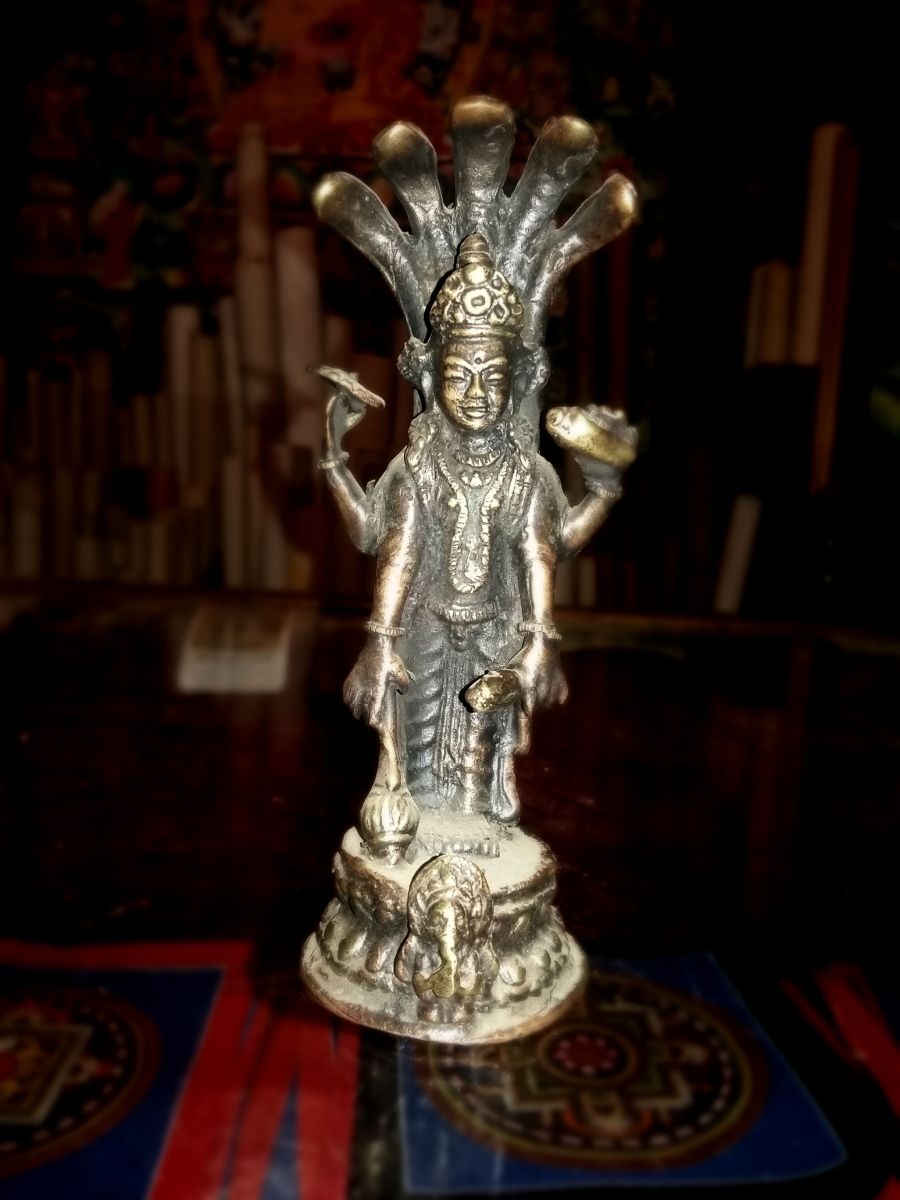

Brass Vishnu Statue 30 Years Plus
In Hindu sacred texts, Vishnu is usually described as having dark complexion of water-filled clouds and having four arms. He is depicted as a pale blue being, as are his incarnations Rama and Krishna. He holds a padma (lotus flower) in his lower left hand, the Kaumodaki gada (mace) in his lower right hand, the Panchajanya shankha (conch) in his upper left hand and the discus weapon considered to be the most powerful weapon according to Hindu Religion Sudarshana Chakra in his upper right hand.
This is a beautiful old Buddhist statue that carries a deep sense of spirituality and craftsmanship. These statues were made around 15 to 20 years ago and are crafted from pure copper. If the statue has gold, it has a thick layer of gold plating, unlike modern statues where using a lot of gold is expensive.
Skilled artisans, who were well-versed in religious teachings, made these statues. They followed traditional guidelines and sacred texts to create each statue with precise expressions and postures. The artisans believed they were creating representations of gods rather than just ordinary figures. This unique perspective is reflected in the statues themselves. Read More . . .
1. Matsya, the fish, from the Satya Yuga. Vishnu takes the form of a fish to save Manu from the deluge, after which he takes his boat to the new world along with one of every species of plant and animal, gathered in a massive cyclone.
2. Kurma
Kurma, the tortoise, from the Satya Yuga. When the devas and asuras were churning the Ocean of milk in order to get amrita, the nectar of immortality, the mount Mandara they were using as the churning staff started to sink and Vishnu took the form of a tortoise to bear the weight of the mountain.
3. Varaha
Varaha, the boar, from the Satya Yuga. He appeared to defeat Hiranyaksha, a demon who had taken the Earth, or Prithvi, and carried it to the bottom of what is described as the cosmic ocean in the story. The battle between Varaha and Hiranyaksha is believed to have lasted for a thousand years, which the former finally won. Varaha carried the Earth out of the ocean between his tusks and restored it to its place in the universe.
4. Narsimha
Narasimha, the half-man/half-lion, from the Satya Yuga. The rakshasa (Demon) Hiranyakashipu, the elder brother of Hiranyaksha, was granted a powerful boon from brahma, not allowing him to be killed by man or animal, inside or out, day or night, on earth or the stars, with a weapon either living or inanimate. Vishnu descended as an anthropomorphic incarnation, with the body of a man and head and claws of a lion. He then disembowels the rakshasa at the courtyard threshold of his house, at dusk, with his claws, while he lay on his thighs.
5. Vamana
Vamana, a boy, from the Satya Yuga. The fourth descendant of Hiranyakashyap, Bali, with devotion and penance was able to defeat Indra, the god of firmament. This humbled the other deities and extended his authority over the three worlds. The gods appealed to Vishnu for protection and he descended as a boy Vamana. During a yajna (यज्ञ )of the king, Vamana approached him and Bali promised him for whatever he asked. Vamana asked for three paces of land. Bali agreed, and the dwarf then changed his size to that of a giant. He stepped over heaven in his first stride, and the netherworld with the second. Bali realized that Vamana was Vishnu incarnate. In deference, the king offered his head as the third place for Vamana to place his foot. The avatar did so and thus granted Bali immortality. Then in appreciation to Bali and his grandfather Prahlada, Vamana made him ruler of Pathala, the netherworld.
6. Parashurama
Parashurama, warrior with the axe, from the Satya Yuga. He is son of Jamadagni and Renuka and received an axe after a penance to Shiva. He is the first Brahmin-Kshatriya in Hinduism, or warrior-saint, with duties between a Brahmana and a Kshatriya). King Kartavirya Arjuna and his army visited the father of Parashurama at his ashram, and the saint was able to feed them with the divine cow Kamadhenu. The king demanded the cow, Jamadagni refused, and the king took it by force and destroyed the ashram. Parashurama then killed the king at his palace and destroyed his army. In revenge, the sons of Kartavirya killed Jamadagni. Parashurama took a vow to kill every Kshatriya on earth twenty-one times over, and filled five lakes with their blood. Ultimately, his grandfather, rishi Rucheeka, appeared and made him halt. He is a Chiranjeevi (immortal), and believed to be alive today in penance at Mahendragiri.
7. Rama
Rama, the prince and king of Ayodhya, from the Treta Yuga. He is a commonly worshiped avatar in Hinduism, and is thought of as the ideal heroic man. His story is recounted in one of the most widely read scriptures of Hinduism, the Ramayana. While in exile from his own kingdom with his brother Lakshman and the monkey God Hanuman, his wife Sita was abducted by the demon king of Lanka, Ravana. He travelled to Ashoka Vatika in Lanka, killed the demon king and saved Sita.
8. Krishna
Krishna was the eighth son of Devaki and Vasudev, from the Dwapara Yuga. He is also a frequently worshiped deity in Hinduism and an avatar in Vaishnava belief. He appeared alongside his elder brother Balarama. Balarama is regarded generally as an avatar of Shesha. However, Balarama is included as the eighth avatar of Vishnu in the Sri Vaishnava lists, where Buddha is omitted and Krishna appears as the ninth avatar in this list. He particularly included in the lists, where Krishna is removed and becomes the source of all avatars.
9. Buddha
Buddha: Gautama Buddha, the founder of Buddhism, is generally included as an avatar of Vishnu in Hinduism. Buddha may be depicted in Hindu scriptures as a preacher who deludes and leads demons and heretics away from the path of the Vedic scriptures. Another view praises him as a compassionate teacher who preached the path of ahimsa (non-violence).
10. Kalki
Kalki ("Eternity", or "White Horse", or "Destroyer of Filth"), will be the final incarnation of Vishnu, foretold to appear at the end of Kali Yuga, our present epoch. He will be atop a white horse and his sword will be drawn, blazing like a comet. He is the harbinger of end time in Hindu eschatology, and will destroy all unrighteousness and evil at the end of Kali Yuga.
You may also want to read the related articles :
At Handmade Statue, we aim to provide a seamless and user-friendly experience. While our website is not a direct online shopping platform, we have a shopping cart system to make submitting your inquiries easy. Follow these steps to place your order:
Step 1: Browse Our Products
Explore our website to discover a wide range of authentic Nepali handicrafts, including statues, thangkas, singing bowls, wood carvings, jewelry, and more. Click on any product to view detailed descriptions and images.
Step 2: Add Items to Your Inquiry Cart
Click the “Add to Inquiry Cart” button for each product you are interested in. This will help you organize your selections conveniently.
Step 3: Review Your Inquiry Cart
Once you’ve added all your items, review your cart to ensure accuracy before submitting your inquiry.
Step 4: Submit Your Inquiry
Click the “Submit Inquiry” button. Fill out the form with your contact details, selected products, and any specific questions or customization requests.
Step 5: Communicate via Email
Since we don’t have an automated payment system, our team will respond to your inquiry via email. We’ll provide guidance, answer questions, and assist with customization requests.
Step 6: Finalize Your Order
Confirm all product details and customization options with our team. Once everything is finalized, we will provide secure payment instructions.
Step 7: Complete Your Payment
Make the payment through the provided method. After confirmation, we will process and prepare your order for shipment.
Step 8: Shipping and Delivery
We offer worldwide shipping. Once your order is dispatched, we will provide tracking details and shipping information.
Step 9: Receive and Enjoy Your Handicrafts
Unpack your beautiful handmade Nepali products and enjoy the craftsmanship and cultural heritage of Nepal.
Need Assistance?
If you face any issues or have questions while placing your order, contact us via email or mobile communication apps. Our team is dedicated to providing prompt support and a smooth ordering experience.
We hope this straightforward ordering process ensures a delightful and satisfying experience with Handmade Statue. Thank you for choosing us to connect you with the rich heritage of Nepali handicrafts.
Return Policy
We have a 7 days money back policy but buyer have to pay the return shipping charges.
Shipping
- Shipping cost is calculated, based on the shipping weight of the products ordered. THe normal Shipping cost is US$25 for upto 0.5 kgs weight
- We ship Worldwide, Except Russia and India.
- The deliver duration varies for international Shipping location. We normally dispatch the product in 2 -3 business days. Else Buyer will be infromed Personally about the shipping.
Related Products
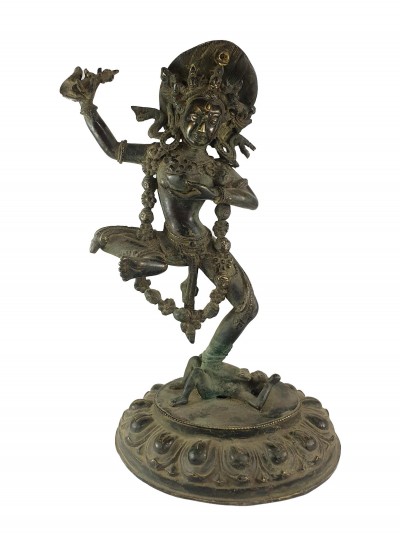
34cm Old Stock, Buddhist Statue Of Vajravarahi - Dorje Phagmo Yogini, Rare Find
Weight : 2.17kg | [23563]
US$900
US$765
You Save
US$135
(15%)
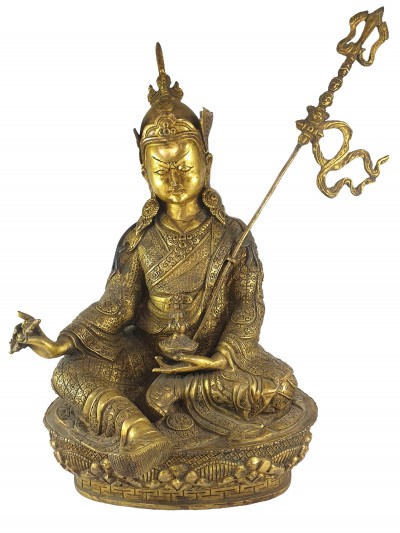
30cm Old Stock, Buddhist Statue Of Padmasambhava, Full Gold Plated, Antique Finishing
Weight : 3.66kg | [23561]
US$1300
US$1105
You Save
US$195
(15%)
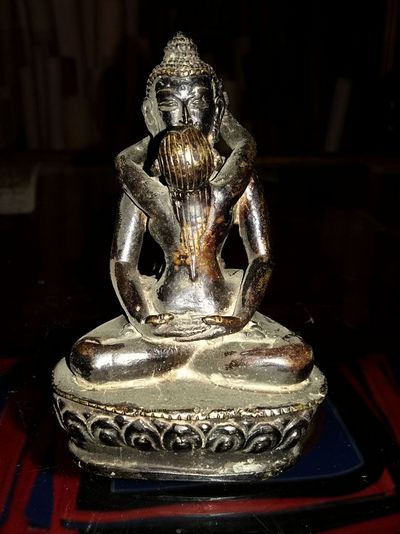
12cm Brass Samantha Bhadra 30 Years Plus
Weight : 0.45kg | [12088]
US$60
US$51
You Save
US$9
(15%)
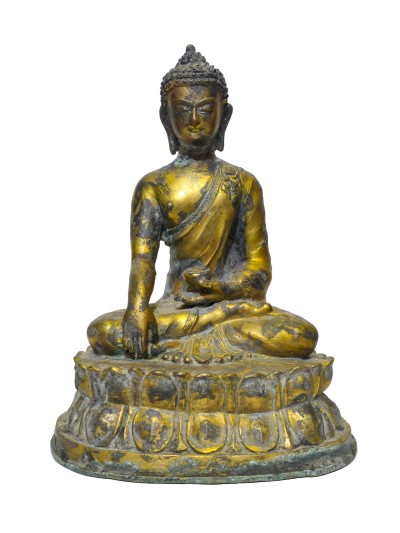
23cm Old, Buddhist Statue Of Shakyamuni Buddha, Gold Plated Antique Finishing
Weight : 1.66kg | [26650]
US$720
US$612
You Save
US$108
(15%)
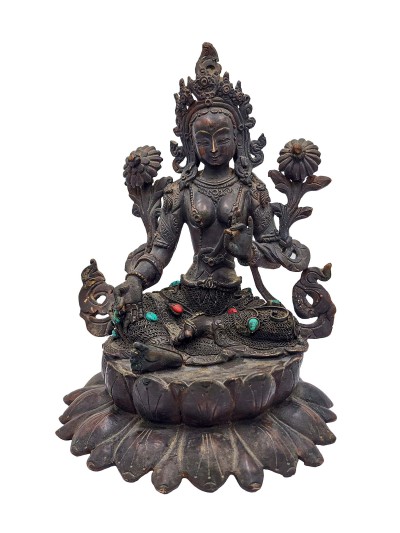
17cm Old Stock, Buddhist Handmade Statue Of Green Tara, Antique Finishing, Stone Setting, Special Seku Design
Weight : 1.06kg | [28874]
US$600
US$480
You Save
US$120
(20%)
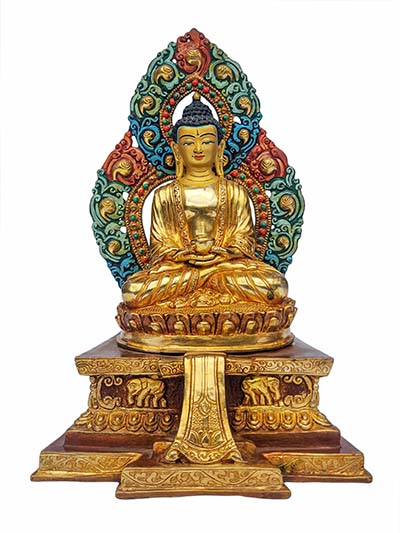
26cm Amitabha Buddha On Throne, Buddhist Handmade Statue, Face Painted, Gold Plated, Rare Find, Old Stock
Weight : 2.32kg | [29808]
US$700
US$560
You Save
US$140
(20%)
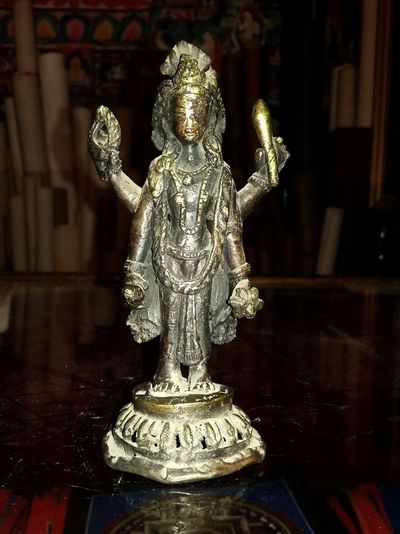
18cm Brass Vishnu Statue 30 Years Plus
Weight : 0.45kg | [12091]
US$60
US$51
You Save
US$9
(15%)
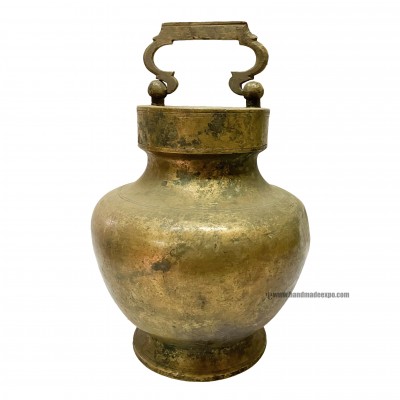
19cm Antique Kamandalu, Vessel
Weight : 1.31kg | [23115]
US$440
US$374
You Save
US$66
(15%)